Cook 7 min read
Can You Use Cast Iron on a Glass Top Stove? (Yes — Here's How)
Yes, cast iron works on a glass top stove — and it's the ideal pan for induction. The real risks ranked, plus the lift-don't-slide technique that prevents them.
This guide has product links. As an Amazon Associate, Seasoned Cast earns from qualifying purchases — it never changes what we recommend.
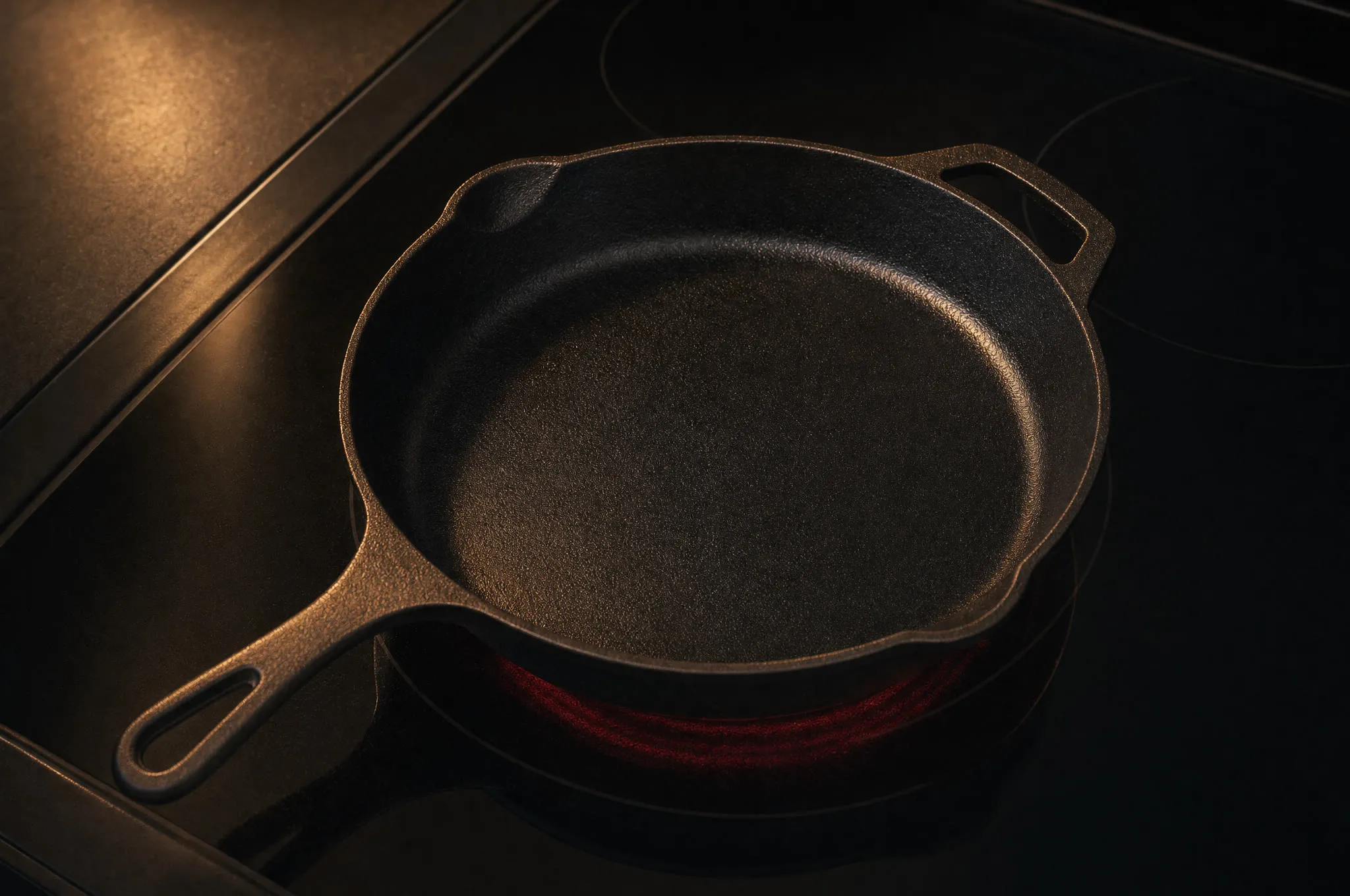
Yes — you can use cast iron on a glass top stove. On induction, it’s not just allowed; it’s the best pan for the job. The worry isn’t baseless: a dragged pan can scratch glass, and a hot pan in the wrong spot can crack it. But every real risk here is a handling problem with a handling fix — lift instead of slide, match the burner, keep the heat moderate.
Here’s each risk ranked by how often it actually happens, and the six habits that let iron and glass share a kitchen for decades.
The real risks, ranked
| Risk | How it happens | How likely | The fix |
|---|---|---|---|
| Scratched glass | Dragging a rough or gritty pan bottom | The common one | Lift, never slide; keep both surfaces clean |
| Cracked glass — impact | Dropping the pan, or setting it down hard | Rare but permanent | Two hands, gentle landings |
| Cracked glass — thermal shock | A ripping-hot pan overhanging the burner onto cold glass, or parked on a cold zone | Rare | Match burner size; let the pan cool where it cooked |
| Overheated cooktop | Long max-heat preheats trapping heat under the pan | Uncommon | Preheat on medium — iron doesn’t need max |
Notice what’s not on the list: anything about cast iron being inherently incompatible with glass. Every failure mode above is a handling error, and every one has a boring, repeatable prevention.
One thing to check rather than guess at: weight. Cooktop manuals commonly warn about heavy cookware, and a loaded Dutch oven weighs more than most people think. There’s no universal limit worth quoting — check your stove’s manual for what it says about heavy pans and canners, and believe it.
First, know which glass top you have
“Glass top” covers two different machines, and the answer gets easier with one of them.
Radiant electric glass tops have a heating element under the ceramic glass. The element cycles full-on and full-off to hold your setting. This is the stove the worry-queries are about, and it’s where the technique below earns its keep.
Induction cooktops generate heat in the pan itself with a magnetic field, and cast iron is ferrous through and through — flat, heavy, and strongly magnetic, which makes it close to the perfect induction pan. Hold a magnet to the bottom of your skillet; it will stick, and induction will drive that pan hard. The surface is still glass, so the scratch rules still apply, but the thermal worries mostly drop away: the glass only warms from the pan sitting on it, not from an element roasting it from below.
If you have induction, read the scratch-prevention parts and cook happy. If you have radiant, keep reading.
Check the pan bottom before it touches the glass
Flip the pan over and run your fingers across the bottom.
- Smooth bottoms are fine. Machined-bottom modern pans and the glassy-smooth bottoms of old vintage iron are kind to glass. Wipe them clean and they’re ready.
- Rough sand-texture bottoms need respect. Most budget modern pans keep the pebbly texture of the casting sand, and that texture is exactly what scratches when it’s dragged. You don’t have to fix it — a lifted pan can’t scratch anything — but if you want insurance, sand the bottom smooth by hand (coarse paper first, a finer pass to finish), wipe off every trace of dust, and let the bare metal pick up a coat during your next round of oven seasoning. Smooth the bottom only; leave the cooking surface alone.
- Warped bottoms are the real problem. Set the pan on a flat counter and press opposite edges. If it rocks or spins, it will sit badly on glass — poor contact, hot spots, an element that cycles longer to compensate. A slight wobble is livable; a pan that spins like a top belongs on a gas flame, not a glass cooktop.
- Heat rings are usually fine. Some vintage pans have a raised ring around the bottom edge, and on glass the pan rides on that ring. If the ring is smooth and the pan sits stable, cook on.
The six habits that make it work
- Clean the glass and wipe the pan bottom before you start. Grit trapped between pan and glass does the actual scratching — a smooth pan sliding over a crumb of burnt sugar scratches just like a rough one. Thirty seconds with a damp cloth beats a permanent scar.
- Match the pan to the burner. Pick the burner closest to the pan’s bottom diameter. A wide pan overhanging a small burner puts screaming-hot iron over cold glass at the rim — that’s the thermal-shock setup — and it heats miserably besides.
- Preheat on medium, and give it time. Cast iron is slow to warm and stubborn about holding what it gets. A few minutes on medium reaches sear territory without cooking the cooktop. If the pan is hazing before food touches it, you’ve overshot — here’s what the smoke is telling you.
- Lift to move. Every time. Repositioning, shaking, plating — pick the pan up. Sliding is the one habit that scratches glass, and it’s also the easiest habit to replace. Two hands if it’s loaded.
- Set it down like it’s full of hot oil. Sometimes it is. Impact is the other way glass dies, and a heavy skillet landing hard concentrates a lot of force into a small ring of iron.
- Let it cool where it cooked. Kill the burner and leave the pan, or move it to a trivet on the counter. Don’t park a hot pan on a cold section of the glass — a steep temperature difference in one spot is how thermal stress starts.
Why cast iron is secretly good on radiant glass
Radiant elements don’t hold a steady output — they cycle full-on and full-off to average out at your setting. A thin aluminum pan telegraphs every cycle to your food: surge, sag, surge. Cast iron’s mass flattens that cycling into steady, even heat. The pan takes longer to get where it’s going, but once there it barely notices the element switching off. For pancakes, smash burgers, cornbread — anything that wants long, level heat — iron on radiant glass is a genuinely good pairing, not a compromise.
That same retention is why you don’t need high settings. Max heat doesn’t preheat iron much faster; the metal absorbs slowly no matter what the element does, so the extra output mostly builds up in the glass while the pan catches up. Medium and patience get you the same pan temperature with far less stress on the cooktop.
Mats and diffusers: the honest answer
You’ll see silicone liner mats and metal heat diffusers sold as glass-top protection. The honest position: cooktop manufacturers mostly say don’t. Anything between pan and glass traps heat against the surface, and silicone that’s fine under a simmering saucepan can scorch under a searing skillet. Metal diffusers force a radiant burner to run longer and hotter to push heat through an extra layer.
Some cooks use thin mats for low-heat work and report no trouble — that’s the debated part, and it’s real. But the protection a mat is selling — insurance against sliding — is free if you just lift the pan. Check your stove’s manual; if it prohibits liners, believe the manual over an accessory listing. The accessory that actually earns its place on a glass top is a cleaner, because clean surfaces are what prevent scratches.
None of this is tiptoeing — it’s the same respect a good pan deserves on any stove. Keep the bottom smooth and clean (the routine habits live in Care), lift when you move it, and let medium heat do the work. For the rest of the heat-control fundamentals — preheating, oil timing, when to trust the pan — head to the Cook section.
FAQ
Will cast iron scratch a glass top stove?
Only if it's dragged. Scratches come from sliding a rough pan bottom — or any pan bottom with grit under it — across the glass. Lift the pan every time you move it and keep both surfaces clean, and the scratch risk essentially disappears. If your pan has a rough sand-texture bottom, sanding it smooth adds insurance.
Can a cast iron pan crack a glass cooktop?
Two ways it can: impact (dropping the pan or banging it down) and thermal shock (a very hot pan overhanging the burner or parked on a cold zone of the glass). Both are avoidable — set the pan down gently with two hands, match the burner size, and let the pan cool where it cooked. Check your stove's manual for its guidance on heavy cookware.
Is cast iron good on an induction cooktop?
It's close to the ideal induction pan. Induction needs magnetic cookware, and cast iron is ferrous through and through, so it couples strongly and heats evenly for its mass. The surface is still glass, so the lift-don't-slide rule still applies, but there's no radiant element cycling to manage.
Should I use a heat diffuser or liner mat under cast iron on glass?
Cooktop manufacturers mostly say no — anything between the pan and the glass traps heat against the surface, and silicone mats can scorch under a hot skillet. Some cooks use thin mats for low-heat work without trouble, but the protection a mat promises is free if you simply lift the pan instead of sliding it.