Care 6 min read
Why Is My Cast Iron Sticky? (And How to Fix It Today)
Sticky cast iron is almost always unpolymerized oil — too much of it, baked too cool. Here's the 30-second diagnosis and the one-hour fix.
This guide has product links. As an Amazon Associate, Seasoned Cast earns from qualifying purchases — it never changes what we recommend.
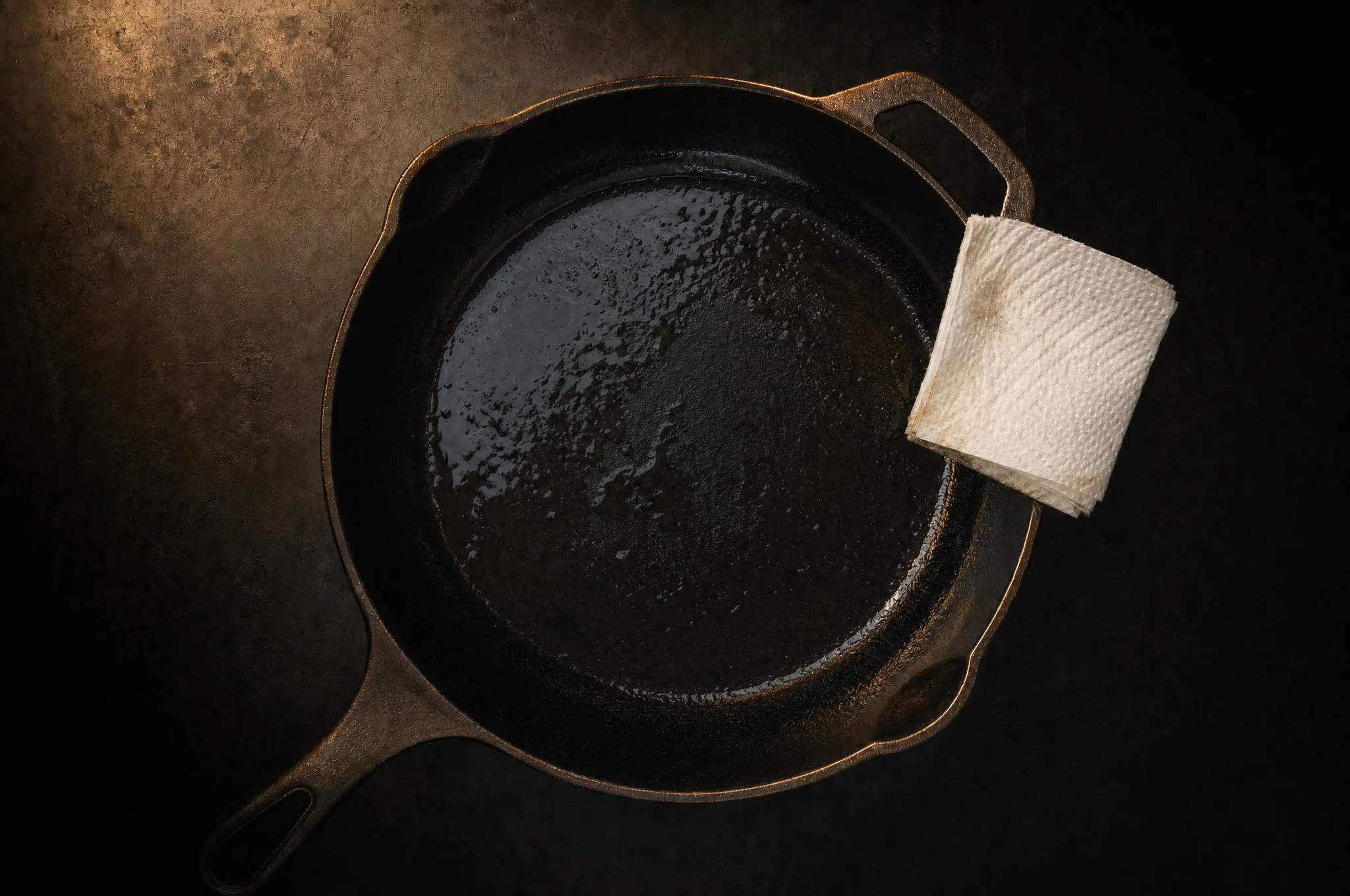
A sticky cast iron pan is almost always unpolymerized oil — oil that was applied too thick, baked too cool, or left in the pan after cooking. It hasn’t bonded into hard seasoning, so it sits on the surface as a tacky varnish. In most cases you don’t need to strip anything: wipe the pan down and give it a hot, dry bake — about an hour at 450–500°F — and the sticky layer finishes hardening in place.
Here’s how to tell which version of the problem you have, and exactly what to do about each.
The 30-second diagnosis
Press a dry fingertip onto the cooking surface of a cool pan and drag it an inch.
| What you feel | What it is | What to do |
|---|---|---|
| Tacky, like tape residue | Oil that never finished polymerizing | Bake it dry (below) |
| Gummy patches or drips you can dent with a fingernail | Way too much oil, usually near the walls or handle | Scrub back, then re-season thin |
| Greasy film that wipes onto a paper towel | Leftover cooking oil, not a seasoning problem | Wash, dry hot, wipe with a drop of oil |
| Rough brown crust that flakes when scraped | Carbonized food buildup, not stickiness | Scrub with salt or chainmail |
One thing that is not on this list: eggs sticking to the pan. That’s a heat-control problem, not a seasoning problem, and it has its own fix. Sticky-to-the-touch is what we’re solving here.
Why seasoning turns sticky
Seasoning is not a coating of oil. It’s oil that has been polymerized — heated past its smoke point in a thin film until the fat molecules crosslink into a hard, plastic-like layer bonded to the iron. Done right, it’s dry to the touch, slightly satin, and dark.
Stickiness means polymerization started but never finished. Two conditions cause nearly all of it:
- Too much oil per coat. A thick film can’t crosslink all the way through. The surface skins over while the oil underneath stays liquid, and you get varnish with a wet basement. This is the single most common seasoning mistake, and it’s why every good seasoning guide repeats the same strange-sounding rule: wipe the oil off like you regret applying it.
- Not enough heat. If the oven sits below the oil’s smoke point, the oil slowly thickens into a soft, gummy lacquer instead of hardening. An oven at 350°F will do this to most oils; 450–500°F will not.
There’s a third, boring cause: the pan was fine, but it went into the cupboard with cooking oil still in it. A month later that film is tacky and smells slightly off. Nothing is wrong with your seasoning — it just needs a wash and a proper wipe-down.
The fix for most pans: bake it dry
If the pan is evenly tacky but smooth — no gummy drips, no flaking — the seasoning is almost done and just needs to be pushed over the finish line.
- Wipe the pan hard with a dry cloth or paper towel. You’re removing any oil that will come off, so only the thinnest film remains. If the towel comes away soaked, keep wiping.
- Put the pan in a cold oven, upside down, on the middle rack. Upside down so nothing pools in the cooking surface. A sheet of foil on the rack below catches any drips.
- Set the oven to 475°F and let it come up to temperature with the pan inside. Once it’s there, bake for one hour.
- Turn the oven off and leave the pan inside to cool. Slow cooling is gentler on the seasoning than a cold counter. When it’s cool enough to touch, the surface should feel dry and satin, not tacky.
Still slightly tacky after one round? Wipe again and repeat once. Two rounds cures nearly anything that’s curable by heat alone.
If it’s gummy: scrub back, then re-season thin
Gummy drips, soft patches you can mark with a fingernail, or blotchy thick spots won’t cure in the oven — there’s simply too much material. Take the surface back down first.
- Scrub the sticky areas with a chainmail scrubber or a handful of coarse salt and a splash of oil, working in circles. You’re shearing off the soft layer, not stripping the pan — stop when it no longer feels gummy. Hot water helps soften it; a drop of dish soap is fine and will not destroy your seasoning.
- Rinse and dry the pan on a burner over medium heat until every trace of water is gone. Water you can’t see is how rust starts.
- Re-season with two or three thin oven coats: wipe on a neutral oil, wipe it all off, bake upside down at 475°F for an hour, cool, repeat.
When to strip the whole pan
Stripping — taking the pan to bare metal with lye, oven-cleaner, or a self-clean cycle — is the nuclear option, and stickiness alone rarely justifies it. Strip when the surface is failing in multiple ways at once: sticky and flaking and rusty, or so blotchy and built-up that you’d be scrubbing for a week to level it. If that’s your pan, it’s not a lost cause — it’s a candidate for a full restoration, which is its own satisfying weekend.
Keeping it from coming back
- Thin coats, always. The wipe-it-all-off rule above prevents the thick-coat failure entirely.
- Season hot. 450–500°F for oven coats. If your kitchen fills with a little smoke haze, that’s the polymer forming — open a window and let it work.
- Use a boring oil. Grapeseed, canola, or avocado. High smoke point, cheap, consistent. Flaxseed builds a beautiful hard finish with a known habit of flaking off in sheets; you don’t need it.
- The 60-second post-cook habit: wash the pan (soap is fine), dry it on a burner until it’s fully dry and hot, wipe in two or three drops of oil, then buff with a towel until the pan looks dry again. That last buff is the difference between seasoning and stickiness.
A sticky pan is one of the most fixable problems in cast iron — it’s the pan telling you it almost has a great surface and just needs the last step. Bake it dry today, wipe thinner tomorrow, and it won’t come back.
FAQ
Is a sticky cast iron pan safe to cook on?
Yes. Sticky seasoning is just oil that hasn't fully hardened — it isn't harmful. The real problems are practical: food sticks to it, dust sticks to it, and old surface oil can eventually smell rancid. If the pan smells like old paint or crayons, scrub the surface back and re-season before cooking.
What's the best oil for seasoning cast iron?
Any neutral oil with a reasonably high smoke point works: grapeseed, canola, avocado, or plain vegetable oil. Flaxseed oil is famous for producing a hard, glassy finish, but that finish is brittle and tends to flake off in sheets. A cheap neutral oil applied thin beats an exotic oil applied thick, every time.
How many coats of seasoning does a pan need after a scrub-back?
Two or three thin oven coats will restore a smooth, working surface, and regular cooking builds it from there. More coats aren't better if they're thick — one thick coat can undo the work of five thin ones by going gummy.
My pan got sticky after someone put it in the dishwasher. Same fix?
Mostly, but check for rust first. Dishwasher detergent and a long soak strip seasoning and often leave orange spots. If it's just dull and tacky, scrub, dry it on a burner, and re-season. If there's rust, deal with the rust first — scrub it back to gray metal before any oil goes on.