Buying 8 min read
Cast Iron vs. Carbon Steel: Which Pan to Buy First (From People Who Love Both)
Cast iron and carbon steel share the same seasoning and care but not the same personality. An honest comparison — and which pan to buy first.
This guide has product links. As an Amazon Associate, Seasoned Cast earns from qualifying purchases — it never changes what we recommend.
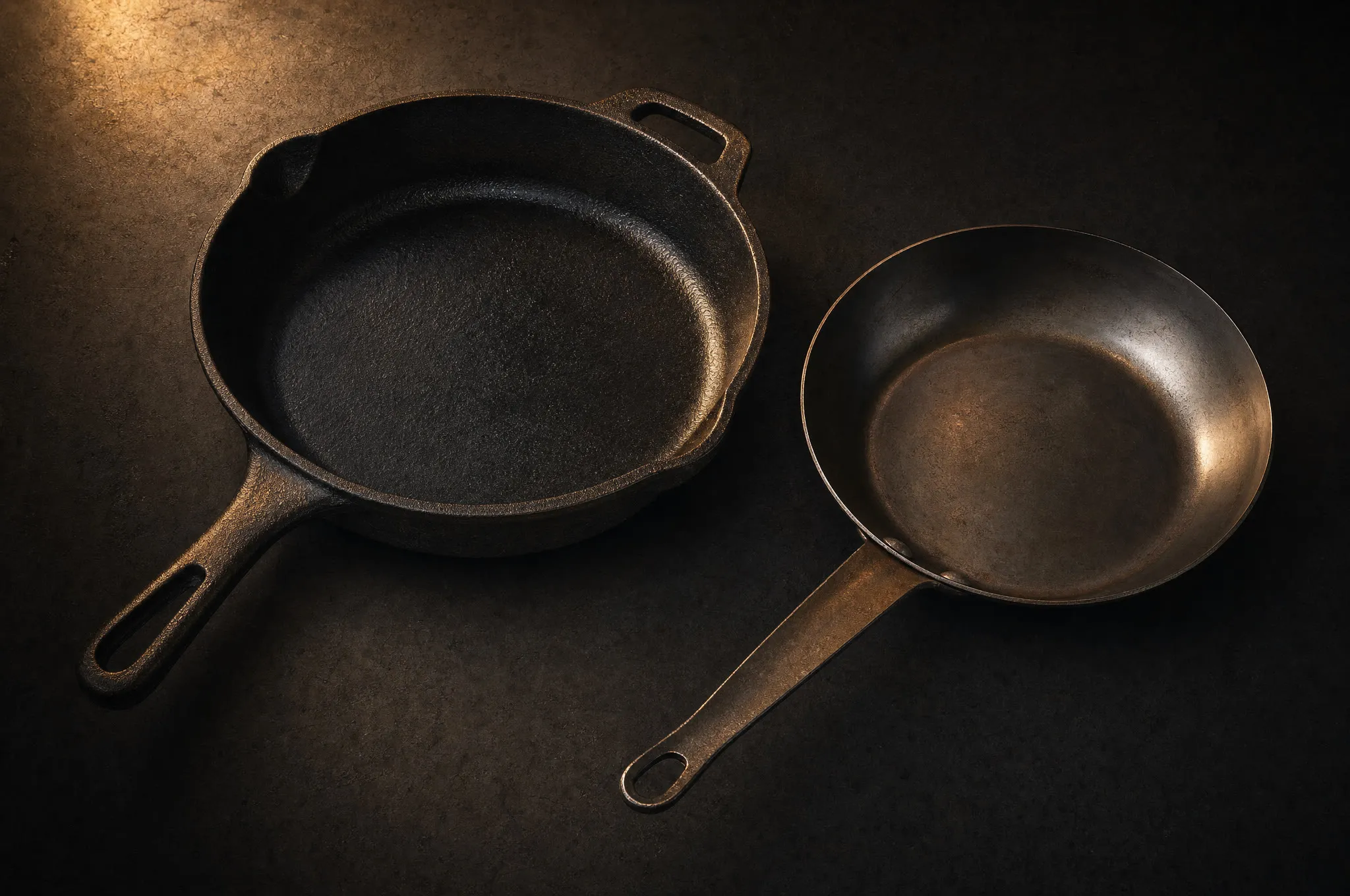
Cast iron and carbon steel are the same material in two different builds — same iron, same seasoning chemistry, same care routine. The difference is mass. Cast iron is thick, so it holds heat: searing, frying, baking. Carbon steel is thin, so it reacts fast: eggs, crepes, stir-fry. Buy for what you cook most — and expect to own both eventually.
Here’s where they actually part ways, and which one earns the first slot in your kitchen.
Same metal, two different builds
Both pans are iron with a little carbon mixed in — close cousins, not different species. Cast iron carries a bit more carbon and gets poured molten into a sand mold, so it comes out thick: cast it thin and it turns fragile. Carbon steel carries a bit less and gets stamped or spun from a flat sheet, so it can be thin, light, and a little springy.
Because the material is nearly identical, the upkeep is identical: the same polymerized-oil seasoning built through the same oven process, the same post-cook wash-dry-wipe, the same grudges against standing water and long-simmered tomato sauce. Learn one and you’ve learned both. What differs is personality — what the pan is like to lift, heat, and cook in every night.
The comparison at a glance
| Cast iron | Carbon steel | |
|---|---|---|
| Weight | Heavy — a two-hand pan | Roughly half the weight |
| Heat retention | Excellent — barely dips when food hits | Moderate — crowding drops the temperature |
| Responsiveness | Slow to heat, slow to change | Follows the burner within moments |
| Walls | Taller, straighter — holds oil, liquid, batter | Low, flared — slides, tosses, vents steam |
| Handle | Short stub, heats with the pan | Long angled lever, built for lifting |
| Price | Cheap new; vintage is the sleeper value | Overlaps cast iron; skip the thinnest bargains |
| Durability | Outlives you; brittle if dropped | Outlives you; thin pans can warp |
| Fire and oven | Shrugs off broilers, coals, campfires | Fully oven-safe; mind thin pans over open fire |
| First pick if you… | Sear, fry, braise, bake | Cook eggs, sauté, stir-fry daily |
Below, those rows expanded — including where each pan honestly annoys us.
Weight: carbon steel wins, and it isn’t close
In comparable sizes, carbon steel runs roughly half the weight of cast iron, and that gap changes how you cook more than any other row on the chart. Carbon steel flips vegetables with a wrist snap and slides an omelet out one-handed. With cast iron, every one of those moves is deliberate — often two-handed — and carrying a full skillet to the sink is a small event.
Weight is also the quiet reason pans go unused: the pan you cook with daily is the one that’s easy to pick up. If wrist strength is part of your reality, weight may be the whole decision.
Heat: retention versus response
This is the real fork in the road, and each pan takes one branch.
Cast iron holds heat. Mass is thermal ballast — slow to warm up, very hard to knock down. Lay a cold steak in and the surface barely dips; that’s how you get a hard crust edge to edge. Drop battered chicken into the oil and the temperature recovers instead of crashing. Pour cornbread batter into a screaming skillet and the sides fry on contact. Every set-and-hold job — searing, frying, braising, baking — is an argument for mass.
Carbon steel answers the throttle. Less mass means the pan actually follows the burner: lower the flame and it cools in moments, raise it and it climbs just as fast. That’s what eggs want and crepes demand, and it’s why the traditional wok is carbon steel — stir-fry is nothing but rapid heat changes. If you cook by adjusting rather than holding, carbon steel rewards you at every meal.
Each has a flip side. Cast iron punishes impatience: it conducts poorly, so a short preheat leaves hot spots — give it several unhurried minutes to even out. Carbon steel punishes crowding: pile in too much cold food and the sear turns gray. Cook in batches.
Walls and shape
Look at the two pans in profile and you can read their intentions. Carbon steel has low, flared walls: food slides in and out, steam escapes instead of pooling, and a wrist flick sends the contents up the slope and back to the middle. Sauté literally means jump; carbon’s geometry is what makes the jump work.
Cast iron’s walls run taller and closer to vertical, turning the pan into a container: frying oil deep enough to matter, braising liquid around a chicken, batter held in place while it sets. It’s why a cast iron skillet doubles as a baking dish and a carbon pan never quite does. Neither shape is wrong — they’re different tools sharing one name.
Handles
The carbon steel handle is a long, angled strip of steel — a lever, really. It balances the lighter pan, makes tossing possible, and stays grabbable a little longer. It still gets hot. The cast iron handle is a short, thick stub cast in one piece with the pan, and it heats along with everything else — treat it as hot whenever the pan is, and keep a dry towel within reach for both. Larger cast skillets add a helper handle opposite the main one; given the weight, you’ll use it.
Price: closer than the reputations suggest
New for new, there’s no meaningful gap: good versions of both sit in the same neighborhood, and the famous budget cast iron skillets prove cheap can still be excellent. The one trap sits at the bottom of the carbon steel market — the thinnest bargain pans are the ones that warp, so buy carbon steel from a maker known for it, not by lowest price.
The sleeper value in the whole category is vintage cast iron. Older skillets were cast thinner and machined to a smooth cooking face, so they’re lighter and slicker than most modern equivalents — and at estate sales and flea markets they often cost less than new. Rust doesn’t matter; it scrubs off, and the pan re-seasons like nothing happened.
Durability: both outlive you, each with one asterisk
Neither pan has a coating to wear out — the surface is renewable forever. Worst case you strip it back and re-season, and the pan is new again. Both will outlast the stove they sit on.
Now the asterisks. Cast iron is brittle: dropped on tile it can crack, and so can a screaming-hot pan plunged into cold water. Carbon steel bends instead of breaking, and thin pans can warp — a maxed-out burner or a cold rinse on a hot pan puts a slight belly in the base. On gas you might never notice; on a glass-top or induction stove a warped pan spins and heats in a ring. Prevention is identical for both: let pans heat and cool at their own pace.
Ovens, broilers, and open fire
Cast iron does not care what you do to it. Oven, broiler, grill grates, a bed of campfire coals — the entire camp-cooking tradition exists because cast iron shrugs off abuse that would ruin anything else in the kitchen.
Carbon steel is fully oven-safe — it’s one piece of steel — and it spends its working life over restaurant burners more violent than anything at home. The caution is the same warp story: thin pans over uneven, raging coals. If your cooking life includes actual fire, hand cast iron to the flames.
Which one first
Buy cast iron first if your cooking leans on searing, frying, braising, and baking. Steaks, smash burgers, fried chicken, cornbread, a one-pan dinner that starts on the stove and finishes in the oven — the set-and-hold jobs that fill our cooking guides. One inexpensive pan covers burner, oven, broiler, and campfire, and it’s the more forgiving pan to learn seasoning on.
Buy carbon steel first if your daily cooking is eggs, crepes, sautéed vegetables, fish, and stir-fry. That’s lift-and-adjust cooking, and carbon’s light weight and fast response pay you back at every meal. It’s also the pan that behaves most like the nonstick you’re probably replacing — without the disposable coating.
Genuinely torn? Take cast iron. You can cook good eggs in well-seasoned cast iron with a patient preheat; you can’t bake cornbread or shallow-fry safely in a low-walled carbon pan. The generalist wins the first slot.
Why the real answer is eventually both
This isn’t fence-sitting — it’s division of labor. The pans share one care routine, so the second adds zero new maintenance, and neither ever wears out. In a two-pan kitchen the roles sort themselves within a week: cast iron owns the sear, the fry, and everything that touches the oven; carbon steel owns eggs, vegetables, and the weeknight burner.
So the question isn’t which pan — it’s which order. Pick the one that matches most of your dinners, cook on it until the seasoning turns black and slick, then pick up the other and wonder why anyone calls them rivals. More decisions like this live in the buying guides.
FAQ
Do cast iron and carbon steel need different care?
No — and that is the best argument for owning both. Same seasoning process, same rule about drying the pan hot on a burner, same thin wipe of oil after cooking, same caution around long-simmered acidic sauces. Learn the routine on one pan and the second costs you nothing new.
Do both work on induction and glass-top stoves?
Yes. Both are magnetic, so induction is no problem. On glass tops the risks flip: cast iron is heavy enough to crack the surface if dropped or dragged, while a warped carbon steel pan will spin and heat unevenly on dead-flat glass. Lift instead of sliding, and check any carbon pan for a flat base.
Why do restaurant kitchens prefer carbon steel?
Weight and speed. A line cook lifts, tosses, and moves a pan hundreds of times a shift, and carbon steel is roughly half the weight of cast iron with much faster heat response. At home, where the pan mostly sits on the burner, cast iron's heat retention earns back its weight.
Is vintage cast iron actually better than new?
It is lighter and smoother, which many cooks prefer. Older skillets were cast thinner and machined to a smooth cooking face; modern budget pans skip the machining and run heavier. Once seasoned it does not cook fundamentally differently, but a clean vintage skillet with a flat base and no cracks is usually the best value in the category.