Restore 7 min read
Is Rusty Cast Iron Safe to Use? (Yes, With Two Exceptions)
Surface rust isn't a health hazard, and it scrubs off. Here's the severity ladder from orange dust to flaking scale — and the two problems that actually matter.
This guide has product links. As an Amazon Associate, Seasoned Cast earns from qualifying purchases — it never changes what we recommend.
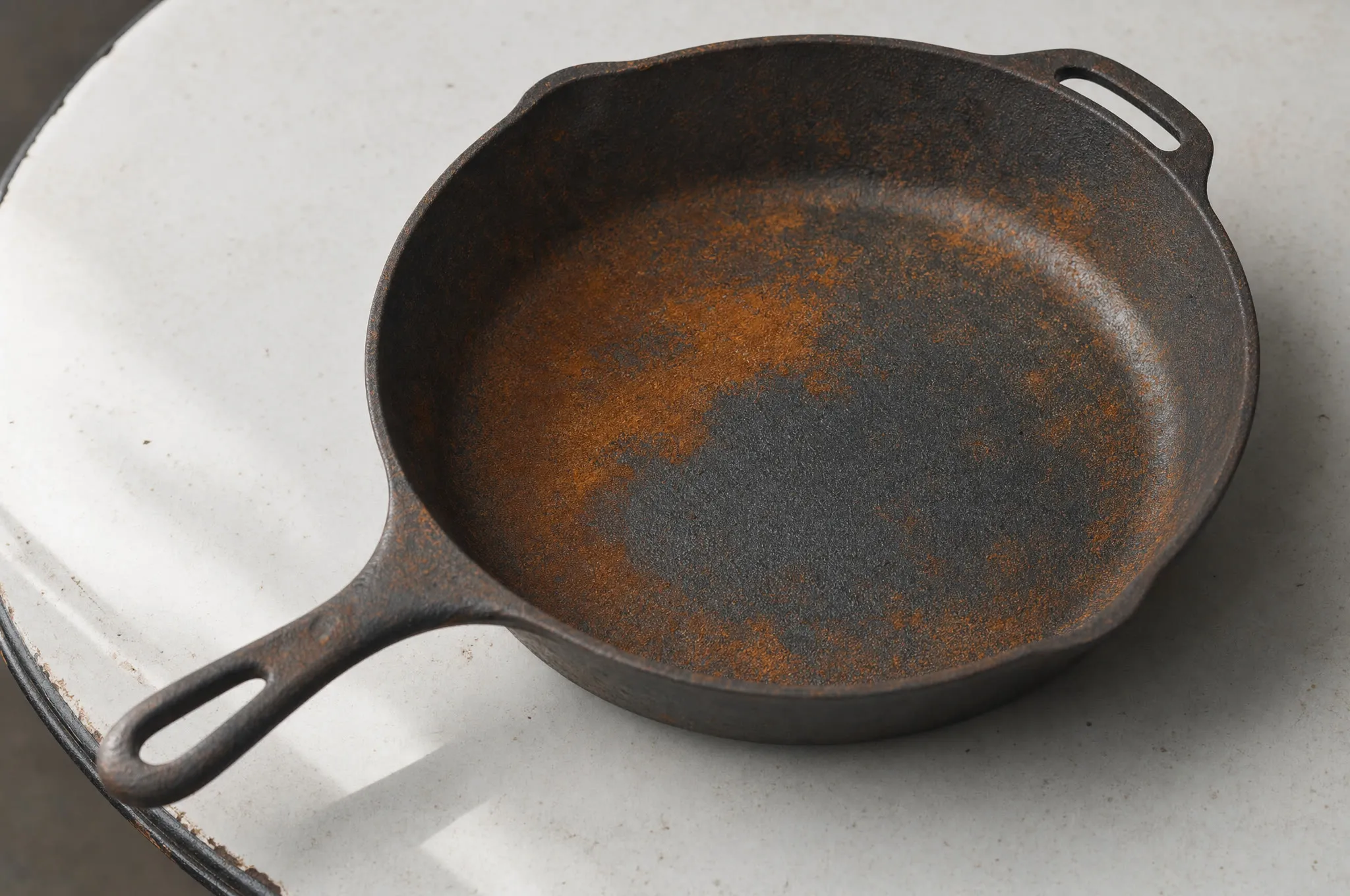
A rusty cast iron pan is safe to use once the rust is scrubbed off — and the rust itself was never the health hazard people fear. Rust is iron oxide, not a toxin, and a skillet cannot give you tetanus. But don’t cook on active rust: it tastes metallic, tints food orange, and means the seasoning underneath has already failed.
Whether the pan came out of grandma’s attic, an estate-sale box, or your own cupboard after a humid summer, it’s almost certainly somewhere between ten minutes and one weekend away from cooking again. Here’s how to read the rust, what each level takes to fix, and the two findings that actually should stop you.
The health question, answered plainly
Rust is what iron does when it meets water and air: it oxidizes. Nothing new arrives — the orange stuff is the same iron your pan is made of, combined with oxygen. If a trace of it ends up in your food from a lightly rusted pan, you’ll notice the taste long before it approaches anything harmful. Eating rust by the spoonful would be a bad idea; the haze on a neglected skillet is nowhere near that conversation.
The tetanus worry deserves a gentle debunking, because most of us were raised on it. Tetanus doesn’t come from rust. It comes from a bacterium that lives in soil and manure, and it needs a puncture wound to get in. Rusty nails earned the reputation by lying in dirt and making exactly that kind of wound. A washed skillet on your stove has neither the bacteria nor a way in. Cooking on it — even rusty — is not a tetanus exposure.
So if rust isn’t dangerous, why does every guide say not to cook on it? Three practical reasons:
- It tastes bad. Metallic and bitter, and it comes through hardest in acidic or delicate food.
- It marks food. Eggs, tortillas, and anything pale will pick up orange.
- It’s a warning light. Rust only forms where seasoning is gone. Wherever the pan is orange, food will stick, and the rust will keep spreading until you deal with it.
Not a hazard. Just a bad cooking surface telling you it needs attention.
Read the rust: three levels
Wipe a dry paper towel across the cooking surface and look at the pan in good light.
| What you see | What it means | What it takes |
|---|---|---|
| Orange haze or dust that wipes onto the towel | Seasoning worn thin; rust just starting | A scrub and a re-season — cook tonight |
| Rough orange-brown patches you can feel with a fingertip | Established surface rust | Scrub to gray or a short vinegar soak, then re-season |
| Flaking scale, heavy crust, orange on every surface | Years of neglect; rust with real depth | A full restoration weekend |
Level 1: orange dusting — cook tonight
If the towel comes back orange but the surface still looks mostly dark, the rust hasn’t gotten anywhere yet. This is the cast iron equivalent of dust.
- Scrub it under hot water with a chainmail scrubber, a stainless pad, or a handful of coarse salt and a splash of oil, working in circles until a rinse-and-wipe comes back clean. Dish soap is fine and will not destroy your pan.
- Dry it on a burner over medium heat until every trace of water has flashed off. Towel-dry is not dry.
- Wipe on a thin coat of neutral oil, wipe it all back off, then either run an oven seasoning round or just cook something fatty. Bacon is a legitimate finishing step. The pan goes back into rotation the same evening.
Level 2: rough patches — steel wool or a vinegar soak
When the rust is established enough to feel — rough patches on the floor or walls, usually after the pan sat wet for days — a quick scrub won’t reach the bottom of it. You have two good options, and neither is a big job. This is the short version; the full walkthrough is at how to remove rust from cast iron.
Option one: scrub it back. Fine steel wool and ten minutes of honest effort takes most surface rust down to clean gray metal. You’re done when the orange is gone and the spot looks like dull nickel — bare iron, ready for oil.
Option two: a vinegar soak, watched closely. Mix white vinegar 1:1 with water and submerge the whole pan. Check it every 30 minutes; the rust wipes away like wet chalk when it’s ready, usually within one to three checks. Never leave it overnight. Vinegar doesn’t know when the rust is gone — it will keep going and etch into healthy iron.
Either way, finish the same:
- Rinse hot and scrub off the loosened residue.
- Dry on a burner immediately. Bare iron can flash a new orange bloom within minutes of meeting air and water — if that happens, wipe it with oil and move on. A fresh haze disappears into the first seasoning coat.
- Re-season with two or three thin oven coats before real cooking.
Level 3: scale and crust — the estate-sale special
This is the $10 skillet under a table of mason jars: orange on every surface, scale flaking off in your hand, decades of baked-on grease around the walls. Nobody should cook on it today — and it’s still probably worth buying. A lot of older iron is lighter and smoother than anything on the shelf now, and rust this bad is still just rust.
Old crud and deep rust are two different problems, removed by two different processes, in this order:
- Strip the grease and dead seasoning first. A lye bath dissolves years of carbon and grease without touching the iron — but it does nothing to rust. Get the organic gunk off so you can see what you’re working with.
- Then take off the rust. For heavy scale, an electrolysis tank lifts rust off without eating healthy iron the way a too-long acid soak can. For middling cases, the vinegar routine above still works.
- Season from bare metal — three or four thin oven coats — and the pan starts its second century.
The whole sequence, with the judgment calls explained, lives in the Restore section.
When to actually worry: the two dealbreakers
Everything above sits between cosmetic and annoying. Two findings are not, and both matter more than any amount of orange.
Deep pitting on the cooking surface
Rust that sits long enough eats down into the metal, and scrubbing it off reveals pits — small craters where iron used to be. Where they are decides whether they matter:
- Outside, walls, or lid: cosmetic. Season over them and cook for another fifty years.
- Shallow, scattered pits on the cooking floor: livable. Seasoning bridges shallow pitting over months of cooking. It may never be your egg pan, but it will fry chicken forever.
- Deep pits across the cooking floor — craters that catch a fingernail: this is the line. The pan will still cook and still won’t hurt you, but that surface will grab food and shed seasoning from the craters for the rest of its life. Don’t spend a restoration weekend or collector prices on it. If you already own it, demote it to rough duty — chili, bacon, campfire — and let a better pan do the delicate work.
A crack
Check a suspect pan after cleaning: sight along the rim and the wall-to-floor corner in raking light. A knuckle-tap helps too — healthy iron rings faintly; a cracked pan tends to thud. Not proof either way, but a dull thud is a reason to look harder before investing a weekend.
The honest summary
Rust — the thing everyone asks about — is almost never the problem. It scrubs off, the iron underneath is fine, and the health scare attached to it belongs to barnyard nails, not skillets. The findings that actually change the plan are cracks and deep pits, the ones nobody asks about. Check for those two, and if your pan passes: it isn’t ruined, it isn’t dangerous, and it’s probably cooking dinner by tomorrow night.
FAQ
Can you get tetanus from a rusty cast iron pan?
No. Tetanus comes from bacteria that live in soil and manure, and it needs a puncture wound to get into you. Rusty nails earned the reputation because they tend to be dirty and cause exactly that kind of wound. A washed skillet in your kitchen has neither the bacteria nor a way in — cooking on it is not a tetanus exposure.
I already cooked on a rusty pan. Should I be worried?
No. The meal may have tasted a little metallic or picked up a faint orange tint, but rust is iron oxide, and the trace amounts involved aren't a poisoning event. Scrub the pan back to gray and re-season it before the next cook so it stops happening.
Does vinegar damage cast iron?
Only when it overstays. Diluted 1:1 with water and checked every 30 minutes, vinegar dissolves rust without drama. Left overnight, it keeps going after the rust is gone and etches into healthy iron. Set a timer and pull the pan the moment rust wipes away.
Is a pitted pan worth restoring?
It depends where the pits are. Pitting on the outside or the walls is cosmetic — restore away. Deep pits across the cooking floor are the dealbreaker: the pan will still cook, but that surface will grab food and shed seasoning in the craters forever. Save the restoration weekend for a better candidate.