Vintage 6 min read
What Is a Heat Ring on Cast Iron? (And Why Collectors Argue About It)
A heat ring is the raised ridge circling the underside of old cast iron. What it was for is debated; what it signals about age is useful. Here's how to read one.
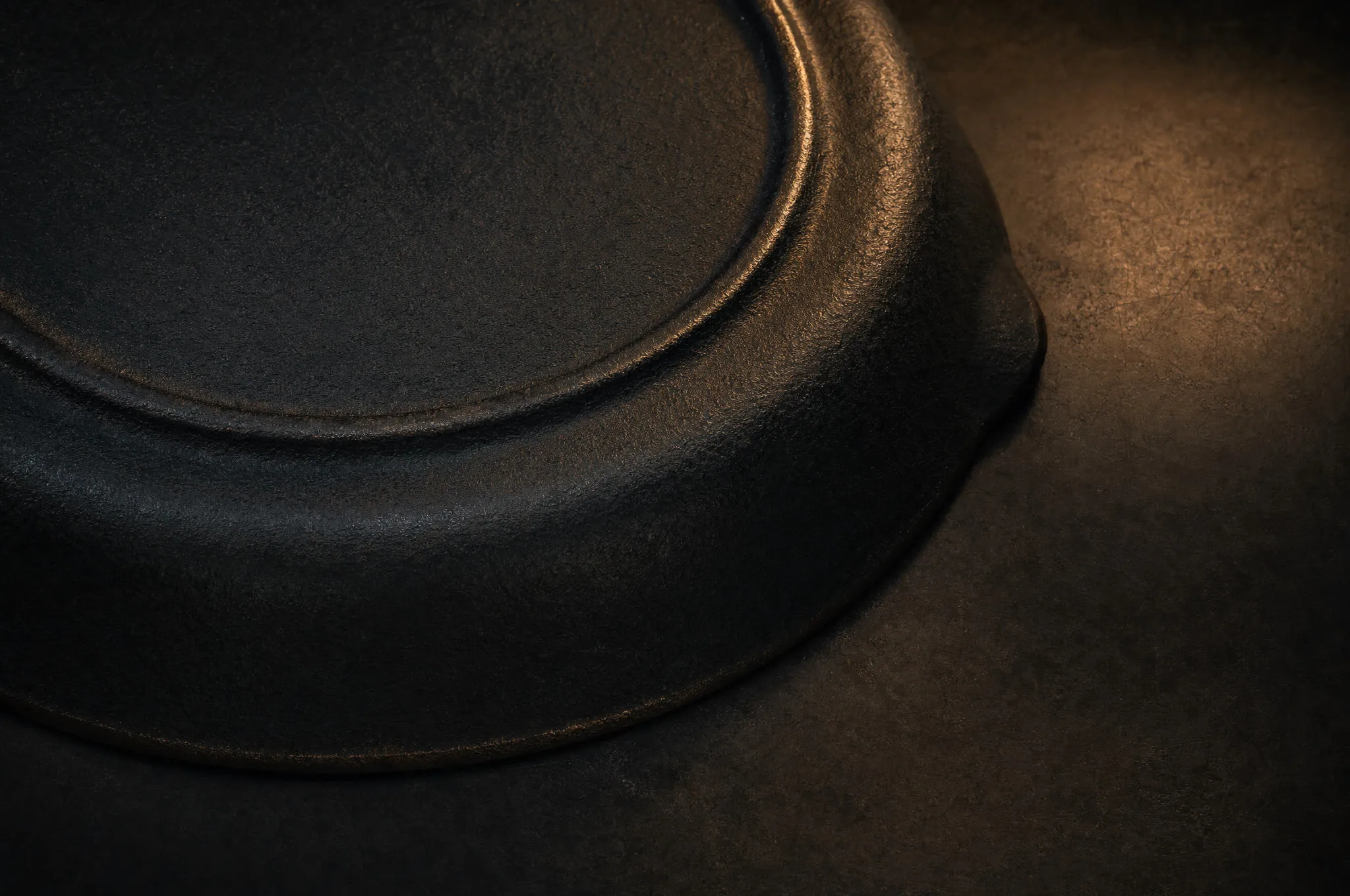
A heat ring is the smooth, raised ridge of iron that circles the underside of a cast iron pan just inside the outer edge — molded in at the foundry, not added after. It generally marks a pan from the wood-and-coal-stove era of manufacture. And the honest answer to what it was actually for is that collectors are still arguing.
Here’s how to recognize one, where the arguments stand, what it tells you about a pan’s age, and whether it changes anything on a modern stove.
What you’re looking at
Flip the pan over. A heat ring runs around the bottom near the outside edge — a narrow, even ridge standing slightly proud of the base, tracing the pan’s curve in a clean circle. Some rings run unbroken all the way around. Some are interrupted by small cast-in gaps called notches. Either way the ridge is smooth: run a finger along it and it feels deliberate, because it is. The ring was part of the mold, poured with the pan.
That smoothness is the fastest way to tell it from the other famous bottom feature, the gate mark — a rough scar of filed-down iron where molten metal entered the mold. The ring is design; the scar is process. One pan can wear both.
You’ll also hear the same ridge called a smoke ring. Same feature, older nickname — and a small clue about one of the theories below.
What it was for — the honest answer
Nobody has settled this, and you should side-eye any article that claims otherwise. If the foundries ever wrote down the official purpose, the document hasn’t surfaced. What we have is a feature that shows up on an enormous share of old American iron, and a few competing explanations that collectors have argued ever since.
The stove-eye explanation — the front-runner. Wood and coal ranges had removable round lids, called eyes, set into the cooktop. Lift one out and there’s an opening straight down toward the fire. The claim: the ring seated the pan in that opening, registering it in place over direct heat. The old smoke ring nickname carries the companion claim — that the seated ring helped close the gap the lid left, keeping smoke out of the kitchen. It’s a tidy story, and the timing fits: rings faded from production as wood stoves faded from kitchens.
The stability and stiffness explanations. A thin flat disc of cast iron wants to warp; a ridge around its rim stiffens it, the way a rolled lip stiffens a baking sheet. Related versions of the argument say the ring steadied pans on stove plates that were never machined flat, or kept the base from sitting dead against a scorching lid. Each version has believers, and each has skeptics pointing out pans and stoves that don’t fit.
The likeliest truth is boring: the ring probably did more than one of these jobs, it varied by maker and by decade, and nobody at the time thought the reason needed writing down — the way nobody today documents why a saucepan handle is the length it is. So hold the history loosely, and use the ring for what it can actually do: help read a pan’s age.
What it tells you about age
One thing, loosely: older manufacture. Heat rings were the standard bottom through the 1800s and stayed common well into the first half of the 1900s. As wood and coal ranges gave way to gas and electric — flat grates and flat burners, no eyes to seat into — foundries shifted to smooth bottoms, and by roughly the mid-1900s the ring had mostly left production.
So the ring sorts pans into loose eras, nothing tighter. Ring: generally the wood-stove era, the 1800s into the early-to-mid 1900s. No ring: generally mid-1900s or later. And the exceptions cut both ways — some makers sold ringed and smooth-bottom lines side by side for years, and modern reproductions of collectible pans exist, ring and all. The ring is evidence, never proof.
If you want tighter than a loose era, the ring has to be read together with the maker’s mark — more on that below — and the rest of the vintage identification toolkit.
Full ring, notched ring, no ring
| The bottom shows | General reading |
|---|---|
| Full unbroken ring | The older pattern — standard through the 1800s and into the early 1900s |
| Notched ring — small cast-in gaps | Mostly a 20th-century pattern; notch count and placement work like a fingerprint for attributing unmarked pans |
| No ring | Generally later — the smooth-bottom era, roughly mid-1900s on — with exceptions by maker and line |
The notched ring earns a note of its own. Plenty of 20th-century pans left the foundry with no name on them at all, and on those, the notch pattern is often the best attribution clue there is. The best-known example: an otherwise unmarked skillet with three notches in the ring usually gets read as mid-century Lodge. Guides to unmarked iron lean hard on these patterns — count the notches, note where they sit, and you’ve narrowed the maker before you’ve read a single letter.
Why the notches are there is — you guessed it — also debated. Treat every explanation you hear as folklore until someone produces a foundry drawing.
Does it matter for cooking today?
On a gas grate or in the oven: no. The ring neither helps nor hurts, and the pan doesn’t care.
On a flat glass or ceramic cooktop it matters in one specific way: the pan stands on the ring. The flat of the base rides just above the glass, and the ring — a narrow line of contact — is all that actually touches. A true ring sits steady and cooks fine. A warped one rocks, and a rocking pan concentrates heat wherever it touches. The full picture — weight, scratching, warp checks, and how ringed pans behave on radiant glass — lives in the glass-top stove guide.
Reading the ring with the name
On marked pans, the ring earns its keep in combination. The big foundries ran for decades and changed logos along the way, and many of those logos exist both with and without a heat ring. As a rule of thumb, within the same maker and logo style, the ringed version is usually the earlier one — the design carried over from the wood-stove years, then got dropped as smooth bottoms took over. A rule of thumb, not a law; the guides handle the exceptions.
That combination — which logo, plus ring or no ring — is exactly how dating works in practice. If your pan says Griswold, the Griswold identification guide walks the logo eras and where the heat ring fits in each. Wagner runs the same way: Wagner Ware identification sorts marks and bottoms into date ranges. Bring both facts to the table and the range narrows fast.
The ring that became a logo
The heat ring never needed a settled explanation to earn its status. Whatever the foundries meant by it, a century later it’s the visual shorthand for old iron — the shape your eye checks first when a flea-market pan gets flipped over, before you’ve read a word on the casting.
We’ll own that bias: it’s on the masthead. The Seasoned Cast mark is a heat ring — when this site needed one shape to stand for the whole subject, there was never really a second candidate. So flip your pan. If there’s a ring under there, you’re holding a design from the era it was built for — and now you know both sides of the argument about why.
FAQ
What was the heat ring on cast iron pans for?
Honestly: it's debated. The most common explanation is that the ring seated the pan into the open eye of a wood or coal stove, holding it steady over direct heat. Others argue it stiffened the casting against warping, or steadied the pan on stove plates that were never machined flat. If a foundry ever wrote down the official reason, collectors haven't surfaced it — the likeliest answer is that it did more than one job.
Does a heat ring mean my cast iron pan is old?
Generally yes, but loosely. Heat rings were standard through the 1800s and stayed common well into the 1900s, fading as smooth bottoms took over around the mid-1900s. It's a range, not a date — some makers sold ringed and smooth-bottom pans side by side, and modern reproductions cast rings too. Date a pan by the ring plus the maker's mark together, never the ring alone.
Can I use a heat-ring pan on a glass-top stove?
Yes. The pan stands on the ring, so the ring is the only part touching the glass — the flat of the base rides just above it. If the ring is true, the pan sits steady and cooks fine. Check before the first cook: press opposite points of the rim on the cold glass. Rocking means the ring is warped, and a warped ring means uneven contact and hot spots.
Is a heat ring the same as a gate mark?
No. A gate mark is a rough, filed-down scar where molten iron entered the mold, and it dates a pan roughly before the 1890s. A heat ring is a smooth, deliberate ridge that was part of the mold design itself, and pans carried rings for decades longer. One pan can wear both — and on those, the gate mark does the dating.