Vintage 7 min read
Griswold Cast Iron Identification: How to Read Every Mark on the Pan
Flip the pan and read it: Griswold's cross-in-circle logo eras, ERIE marks, size and pattern numbers, heat rings — and the tells that expose a reproduction.
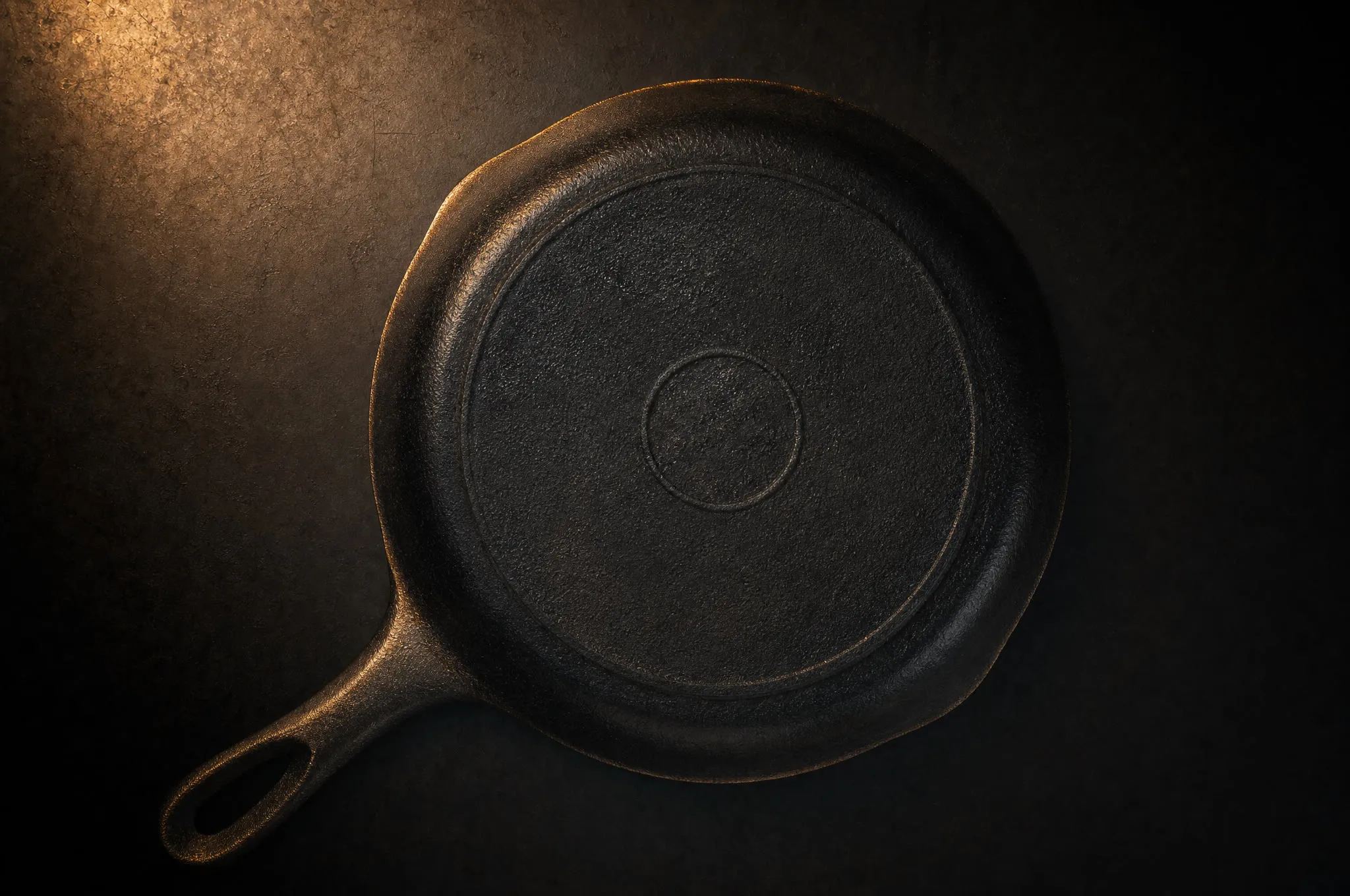
To identify a Griswold, flip the pan and read three things: the logo (a large cross-in-circle is older than the small version), the lettering (slanted came before block), and the numbers (a size number plus a catalog pattern number). “ERIE” with no Griswold name is earlier still — the company’s first era, before the famous logo existed.
Griswold Manufacturing poured iron in Erie, Pennsylvania, from the late 1800s to the middle of the 1900s, and its skillets are the benchmark for American collector cast iron. The marks on the bottom tell you roughly when yours was poured — and the market prices those eras very differently. This is the deep end of vintage identification; here’s how to read one pan, one feature at a time.
Where the marks live
Everything that identifies a Griswold is cast into the bottom. In the center: the logo — or, on the earliest pans, just the word ERIE. Near it: the numbers, size and pattern. At the outer edge, on many pans: a heat ring. The top of the handle usually repeats the size number. Flip the pan, get some raking light on it, and the whole story is readable in under a minute.
The cross-in-circle logo: large versus small
The trademark most people picture is the cross inside a double circle — GRISWOLD running across the cross, ERIE, PA., U.S.A. beneath it. It comes in two broad families, and telling them apart is the fastest dating move you can make.
The large logo spans a big share of the pan’s bottom — you can’t miss it. It belongs to the older stretch of logo production, roughly the earlier decades of the 20th century, and it’s the version collectors chase hardest. All else equal, a large-logo pan draws more interest and more money than the same pan wearing a small logo.
The small logo is the same mark shrunk to a couple of inches across. It came later — production running toward the middle of the century — and it’s by far the most common Griswold you’ll meet. Less collector premium, identical cooking iron. If you want to cook on a Griswold rather than display one, the small logo is the honest entry point.
Slant versus block lettering
Within the logo pans there’s a finer signal: how GRISWOLD is lettered. Slanted italic lettering is earlier; upright block lettering came after and stayed for the rest of the run. So the loose sequence goes: slant-letter large logo, then block-letter large logo, then block-letter small logo.
Treat fonts as a rough sort, not a birth certificate. Griswold ran for decades, patterns got revised, and enough variants exist to keep the deep-end collectors arguing. For a first read — older or later — slant versus block is plenty.
ERIE — the marks before the name
Before the Griswold name went onto the iron at all, the company marked its pans with just the city: ERIE. These are the oldest pieces in the family, from the late 1800s, and they’re prized — partly for age, mostly because the casting was superb: thin walls, light weight, cooking surfaces ground glassy-smooth. A few very early pieces carry a spider-on-a-web trademark; those are rare enough that most collectors never handle one.
The foundry also poured budget and store-brand lines over the years — Victor is the best known — so not every pan from Erie says Griswold. That’s a deeper pool than this guide.
Here’s the sequence in one table:
| Mark on the pan | Loose era | Collector read |
|---|---|---|
| ERIE only, no Griswold name | The earliest — late 1800s | Prized; superb thin castings |
| Large logo, slanted letters | Roughly the early 1900s | The older end of the logo pans |
| Large logo, block letters | Roughly early-to-mid 20th century | The classic collector Griswold |
| Small logo, block letters | Later, toward mid-century | Most common; the affordable way in |
The two numbers: size and pattern
Most Griswolds carry two numbers, and they answer different questions.
The size number — top of the handle, usually repeated on the bottom — is the big one- or two-digit number. It is not inches. It’s a holdover from wood-stove days, when cookware was sized to the numbered eyes on a stove top: a No. 8 pan fit a No. 8 eye, and it measures well over eight inches across the rim. The middle sizes were what every kitchen needed, so they’re what survives in quantity.
The pattern number is the three- or four-digit number cast near the logo. It’s a catalog number identifying the exact casting pattern — the classic example is 704 on the No. 8 skillet. Collectors use pattern numbers to match lids to pans and to check a piece against reference lists. It’s also a quiet authentication tool: on a genuine pan, the size number and pattern number agree. A mismatch means somebody’s pattern is lying.
The heat ring — and the rest of the body
Older Griswold skillets generally carry a heat ring, the raised ring circling the outer edge of the bottom, cast there to seat the pan in a stove eye. As stoves modernized, later production mostly went smooth-bottomed. So on a Griswold: ring generally reads earlier, smooth bottom generally reads later. It’s a supporting witness, not a verdict — read it alongside the logo, never instead of it.
Two more notes from the bottom of the pan. First, you should not find a gate mark — the rough scar-line of bottom-gated casting — on a cross-in-circle Griswold; the logo era came after American foundries abandoned that technique, so a “Griswold” wearing one deserves a hard second look. The gate mark guide sorts the scar from the ring. Second, the body itself is evidence: real Griswold iron is thin, light for its size, and machined smooth on the cooking surface — the very qualities that separate vintage iron from a modern Lodge. If a claimed Griswold feels thick, heavy, and sandpaper-rough inside, doubt the marks no matter how good they look.
What a Griswold is worth, honestly
Collector reality, without the fever:
Condition beats rarity if you cook. A clean, crack-free small-logo skillet will outcook a rare pan with problems every day of the week, and it costs a fraction as much. Buy the pan, not the legend.
Cracks kill value. All of it, if you plan to cook.
Common sizes are cheap; oddities are where the money lives. Mid-size skillets survive in huge numbers and trade constantly, which keeps them affordable. The money concentrates in the unusual — the very small and very large sizes, specialty shapes, scarce variants, the earliest marks. Which is also exactly where the fakes concentrate.
Rust is a discount, not a defect. Surface rust strips right off, and the pan underneath is often excellent — some of the best buys wear the ugliest orange. Deep pitting across the cooking surface is different: on thin vintage iron, that’s usually a pass. And check flat — set the pan on glass and press opposite rim points. A rocker is a wall-hanger at a wall-hanger price, whatever the logo says.
Spotting a reproduction
Fakes exist because the money exists. Most are recasts: someone uses a real pan as the pattern and pours a copy. Iron shrinks as it cools, so a recast comes out slightly smaller than the original — and every mark comes out soft. That gives you the tells:
- Casting crispness. Genuine Griswold lettering is sharp-edged and clean. Recast marks look melted — shallow, blurry, rounded.
- Surface and weight. Real pans are thin and light, machined smooth inside. Repros run thick and heavy with a rough, grainy finish.
- Fonts. Reproduction patterns often get the lettering subtly wrong — spacing, letter shapes, the logo’s proportions. If it looks off next to verified photos, believe your eye.
- The numbers. The size and pattern number should agree, and both should match the logo era they’re wearing.
Where do fakes surface? Wherever rarity meets a friendly price: the scarce piece at a too-good number, the online listing with one dark photo. If the rarity is high and the deal is easy, assume reproduction until the pan proves otherwise.
Reading the pan, start to finish
Logo size, letter style, ERIE or not, two numbers, ring or no ring — five features, and you can place a Griswold in its loose era and screen out most fakes at arm’s length. Do that much, then apply the only test the pan actually cares about: does it ring clear, sit flat, and take a season? The name on the bottom is what made these skillets collectible. The iron underneath is what still makes them worth cooking on.
FAQ
How can I tell how old my Griswold skillet is?
Read the marks in sequence. Plain ERIE with no Griswold name is the earliest era, from the late 1800s. The cross-in-circle logo came after — slanted lettering before block, large logo before small — spanning roughly the early-to-mid 20th century. A heat ring generally points earlier, a smooth bottom later. The marks give you a loose era, not a year; getting tighter takes pattern-level reference work.
What does ERIE mean on an old cast iron pan?
Erie, Pennsylvania — the foundry's home town, and the mark the company used before the Griswold name went onto the iron at all. ERIE-marked pans are the oldest of the family, from the late 1800s, and collectors prize them for casting quality as much as age: thin, light, and glassy-smooth.
Is small-logo Griswold worth buying?
For cooking, absolutely. Small-logo pans are later production and the most common Griswolds around, so they carry the least collector premium — but the iron is the same thin, machined-smooth casting the name is famous for. A clean small-logo skillet is the cheapest honest way to own the brand.
How do I spot a fake Griswold?
Weight and crispness. Genuine pans are thin and light with sharp lettering and a machined-smooth cooking surface. Most fakes are recasts of real pans: slightly smaller, heavier-feeling, rough and grainy, with shallow blurry marks and often subtly wrong fonts. Be most suspicious exactly where the money is — rare pieces at friendly prices.