Vintage 7 min read
Wagner Ware Cast Iron Identification (Reading a Sidney, Ohio Pan)
Wagner marked its iron many ways over the decades — arc logos, the Sidney -O- stamp, bare pattern numbers. How to read each mark and judge the pan under it.
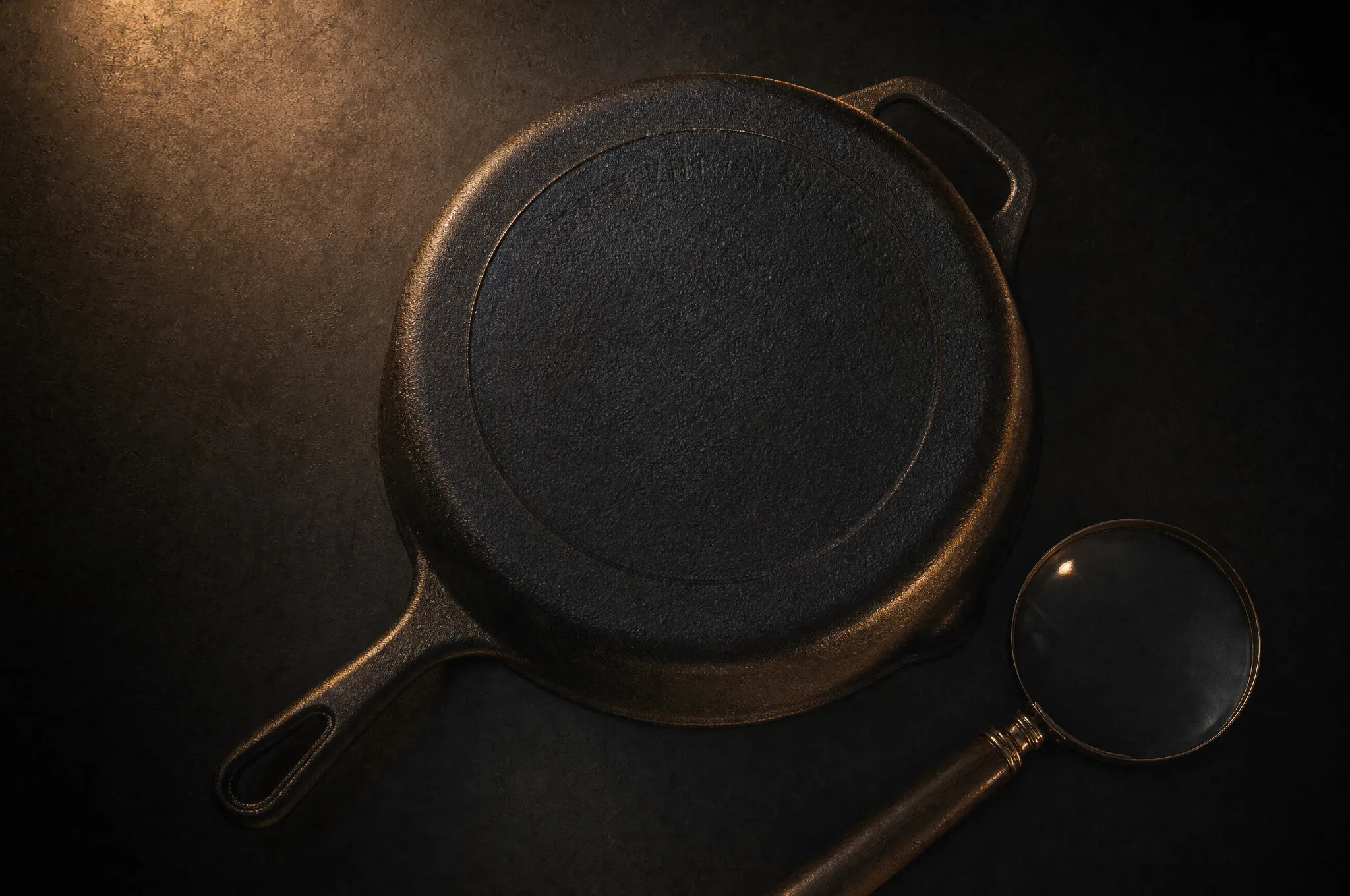
A vintage Wagner identifies itself on the bottom. Earlier pieces say “WAGNER” in an arc of block letters. Later ones carry the stylized “Wagner Ware Sidney -O-” trademark — the -O- is Ohio. And plenty of genuine Wagners say nothing at all: just a size or pattern number over a smooth, machined casting poured in Sidney, Ohio.
Here’s how to read each mark family, what the unmarked pieces give away, and how to decide whether the Wagner in front of you is a cooker or a wall piece.
The company, in one paragraph
Wagner poured hollowware in Sidney, Ohio, from the closing years of the 1800s deep into the middle of the 1900s. Alongside Griswold of Erie, Pennsylvania, it was one of the two giants of American cast iron — skillets, dutch ovens, griddles, and roasters by the trainload. That volume is why identification is a skill at all: across that many decades, the marks changed again and again. You don’t need to memorize every variation — you need the families.
The named marks
Flip the pan and read the bottom.
| What’s cast on the bottom | What it is | What it tells you |
|---|---|---|
| ”WAGNER” in an arc of block letters, sometimes with “SIDNEY O.” | The early mark family | Earlier production, generally — the plainer the mark, the earlier it tends to run |
| ”WAGNER WARE” over “SIDNEY -O-” in stylized lettering | The signature trademark | A real Wagner from the company’s long mature era; it ran for decades, so it brands the pan more than it dates it |
| No name — a size number, sometimes a pattern number | Unmarked production | Not a knockoff; Wagner shipped plenty of unmarked iron |
| ”WAGNER’S 1891 ORIGINAL” | A commemorative series | Modern, not antique — made roughly a century after the date in the name |
The arc. Wagner’s earlier habit was its own name in plain block letters, curved in an arc, sometimes with the town underneath. The plainer and sparser the mark, the earlier the piece tends to run — but “tends” is the honest word. Collectors date arc-marked pans to narrow windows by comparing typefaces, added words, and mold details against reference catalogs, and that’s real bookshelf work. The broad read you can trust without the books: an arced WAGNER is generally the older mark family.
The Sidney -O-. The stylized “Wagner Ware” over “Sidney -O-” is the mark most people picture when they hear the name. The -O- puzzles first-timers, but it’s nothing cryptic: the town spelled out, the state shrunk to one letter between dashes. Sidney, Ohio. The trademark ran across enormous production for decades, so it confirms the maker without pinning the year. Getting tighter than that takes pattern numbers and catalog-level reference work — the deep end of vintage identification.
Size numbers and pattern numbers
The number on a Wagner is not inches. Like the rest of the old American foundries, Wagner sized its ware to the stove-eye system left over from wood and coal ranges, so a No. 8 skillet doesn’t measure eight inches across the top. The size number usually rides the handle or the bottom — useful mostly for matching pans to lids.
Many pieces also carry a pattern number: the foundry’s mold code, cast small into the underside. Pattern numbers are the fine-grained evidence collectors use to separate one variation from another — a detail you’ll care about later, if the collecting bug bites.
The unmarked Wagners
Plenty of genuine Wagner iron left Sidney with no name on it at all. Some was contract production sold under store brands; some lines simply weren’t marked. An unmarked bottom is not evidence of a knockoff — for iron this old, it’s normal.
Attribution then works by style instead of signature, and it works to a probability, never a certainty:
- The cooking surface is machined smooth. Wagner ground its surfaces at the foundry. Under the seasoning, the iron should feel like glass, not sandpaper.
- The casting is thin and light. Pick it up. A vintage Wagner is noticeably lighter than a modern skillet the same size, with thinner walls and a thinner base.
- The details match a marked example. Handle profile, the font and placement of the size number, the shape of the pour spouts — these are the tells collectors actually lean on, checked side by side against a pan that carries the trademark.
A pan matched this way is “attributed to Wagner,” and that’s as strong as the claim gets. If you’re buying a cooker rather than a collectible, attribution barely matters anyway — the iron doesn’t know what it’s called.
Wagner and Griswold, late in the story
For most of their lives the two giants were rivals. Late in both companies’ lives, the brands ended up under the same ownership, and by the middle of the 1900s both names were coming out of shared corporate hands. For mark-reading, that era matters twice over. Very late pieces of either brand can mix details that never appeared together in the classic years — right name, odd style. And collectors generally rate the late consolidated production a step below each company’s earlier work, which keeps its prices closer to cookware than to trophies.
So when a mark combination looks off, suspect the late era before you suspect a fake. Griswold, with its bigger premiums, attracts most of the actual fakery — reading that brand is its own subject.
Why Wagner is the value collector’s brand
Griswold wears the crown at auction, and the gap is real. It is mostly not a gap in the iron. Wagner’s casting, machining, and cooking behavior stand shoulder to shoulder with Griswold’s — thin walls, light weight, surfaces ground smooth — and a sound example of either turns out the same eggs. What the Griswold premium buys is the logo.
That’s the whole case for Wagner: comparable quality, softer prices, and a huge surviving supply, because Sidney shipped iron by the boxcar. If the goal is vintage iron to cook on rather than iron to insure, Wagner is where the money goes furthest.
Judging the one in your hands
The mark tells you who poured it. Condition decides whether you buy it. Three checks, a few minutes, no tools.
1. Ring it. Hold the pan loosely by the handle, or dangle it from a finger through the hanging hole, and rap the rim with a knuckle at several points. Sound iron rings — a clear, brief tone. A crack kills the ring: you get a dull thud or a buzzy rattle instead. Cracks hide at the handle base and under old crud, so trust your ear over your eyes.
2. Set it on glass. Wagner’s thin castings have been through decades of heat cycles, and warp happens. On the flattest surface you have — a glass cooktop or stone counter — press opposite points of the rim, then give the pan a slow spin. Rocking under pressure means warp; an easy spin means a crowned base. Mild warp is livable on a gas grate and annoying on a flat-top, and the honest options are covered in the warp guide.
3. Read the pitting in raking light. Scattered shallow pits are cosmetic — seasoning fills them and food never notices. Deep, clustered pitting across the middle of the cooking surface grabs food and harbors rust, and on thin vintage iron it’s usually a pass. Where that line sits is covered in the rust-safety guide.
Rust and grime, on the other hand, are Saturday problems. A crusted Wagner that rings clear and sits flat is a routine restoration — removing the rust works the same on old iron as on new. One habit worth keeping with a pan this age: strip gently. Lye and electrolysis lift buildup without touching the metal underneath; aggressive grinding removes iron a thin casting can’t spare and can blur the very marks you just learned to read.
Then cook on it. A sound Wagner is lighter, smoother, and quicker on its feet than almost anything on the store shelf today — the old-versus-new comparison isn’t close on weight or finish — and the market still prices most of them like cookware instead of collectibles. Read the bottom, ring the rim, set it on glass, and if it passes, put Sidney, Ohio back over a flame.
FAQ
What does the -O- mean on Wagner Ware cast iron?
Ohio. Wagner poured its iron in Sidney, Ohio, and the trademark spells out the town while squeezing the state down to a single letter set between dashes — 'Wagner Ware Sidney -O-' reads as 'Wagner Ware, Sidney, Ohio.' It's a hometown stamp, not a code, and it's the most recognizable mark the company ever used.
How do I identify an unmarked Wagner skillet?
By style, and only to a probability. Compare it against a marked Wagner: a cooking surface machined smooth, a thin light casting, and a handle shape and size-number style that match. A pan like that is 'attributed to Wagner' — collectors don't claim more without a logo. If certainty matters because collector money is changing hands, buy the marked pan instead.
Is Wagner cast iron as good as Griswold?
On the stove, effectively yes. Both companies poured thin, light iron with machined-smooth cooking surfaces for decades, and a sound example of either cooks the same breakfast. The price gap between them is mostly collector demand for the Griswold logo. That gap is exactly what makes Wagner the value pick: comparable iron, softer price.
Is a pan marked 'Wagner's 1891 Original' an antique?
No. That series is a commemorative line made roughly a century after the date in its name — the 1891 refers to the company's founding story, not the year the pan was poured. The pieces run heavier and rougher than true vintage Wagner production. Honest cookware, fine to use, but not old and not collectible.