Care 6 min read
Cast Iron Rusted in the Dishwasher? It's an Afternoon Fix
A dishwasher cycle strips seasoning and flash-rusts bare cast iron. The good news: it's surface rust — an afternoon of scrubbing and thin oil coats fixes it.
This guide has product links. As an Amazon Associate, Seasoned Cast earns from qualifying purchases — it never changes what we recommend.
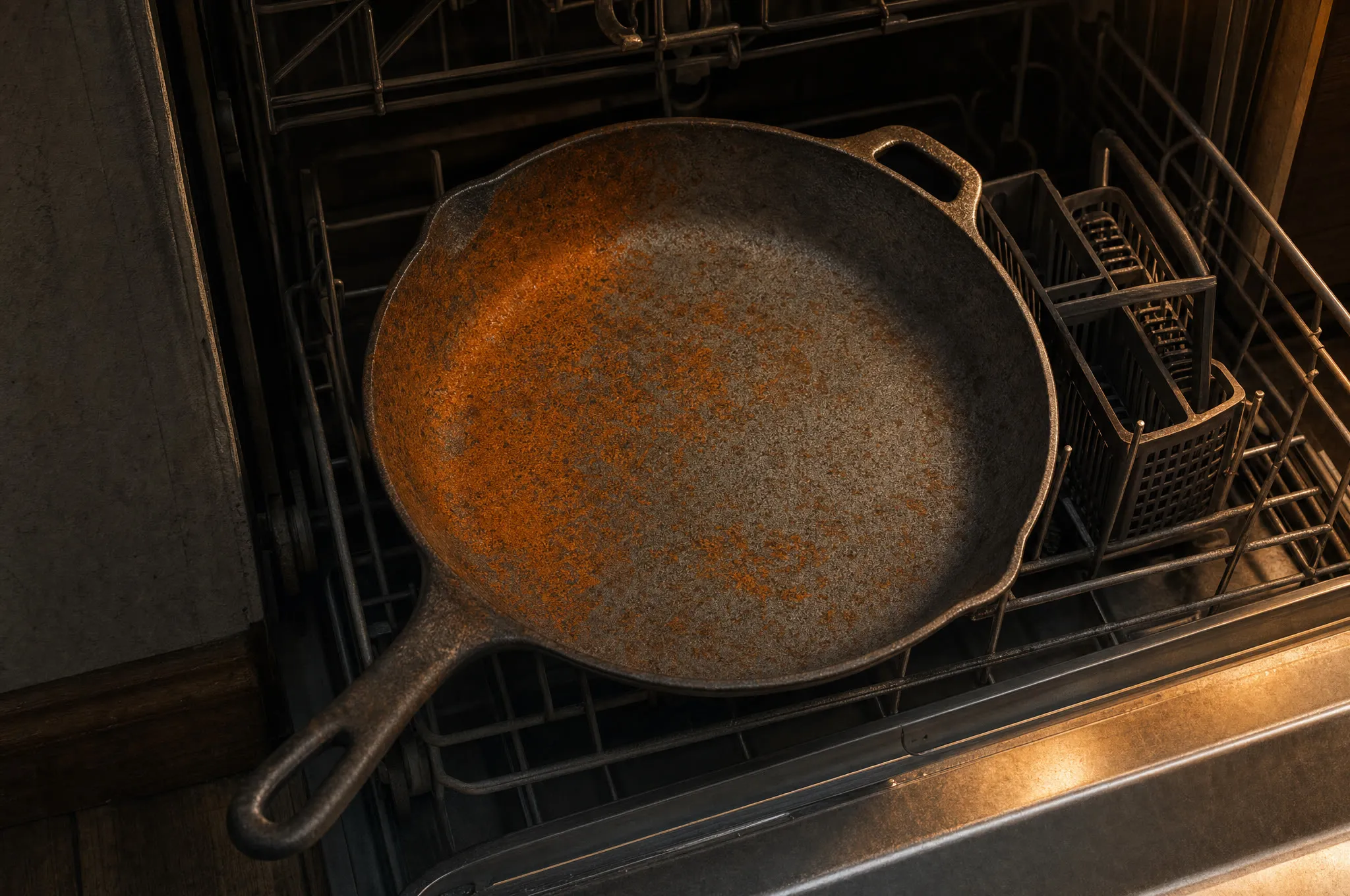
Your pan is fine. A dishwasher cycle strips cast iron’s seasoning, and the bare metal flash-rusts in the hot steam — but that orange bloom is surface rust, thinner than a coat of paint. Scrub it off with steel wool, dry the pan on a burner, bake on two or three thin coats of oil, and you can cook dinner in it tonight.
And go easy on whoever did it. Somebody looked at a dirty pan, loaded it with the rest of the dishes, and pressed start. That’s a person doing the dishes, which is not a crime. The cast-iron-never-goes-in-the-dishwasher rule is folklore most households learn by breaking it exactly once. Today is your once, and it costs you an afternoon, not a skillet.
What actually happened in there
Seasoning isn’t a mystery coating. It’s oil baked past its smoke point in thin layers until it polymerizes — crosslinks into a hard, dark film bonded to the iron. Chemically speaking, seasoning is baked-on fat.
Now consider what a dishwasher is built to do: destroy baked-on fat. That’s the whole product. Hand dish soap is a mild detergent that lifts loose grease and rinses away; machine detergent is a far harsher formula designed to dissolve hardened, cooked-on grease films — which is a precise description of your seasoning.
Then the machine gives that detergent every advantage:
- Time. A wash cycle is closer to a long soak than a scrub. The pan sits hot, wet, and under chemical attack the entire time.
- Heat. Hot water speeds the stripping along, and the heated-dry cycle finishes the job.
- Steam. Bare iron rusts fastest when it’s warm and damp — and a dishwasher at the end of its cycle is a warm, damp box. The freshly stripped iron flash-rusted before the door ever opened.
That’s why the pan went in black and came out gray and orange. Nothing melted, nothing warped, nothing cracked. The seasoning left, and the iron did what naked iron does in steam.
Here’s the part that matters for the rescue: rust that formed in a single cycle is shallow. It’s a powdery bloom sitting on top of the metal, not pitting eaten into it. It has no grip, and it comes off almost embarrassingly fast.
The rescue: scrub, dry, re-season
About twenty minutes of hands-on work. The oven does the rest of the afternoon.
- Scrub the orange back to gray. Steel wool, hot water, and a drop of dish soap, working in circles with real pressure — you can’t hurt this pan with your hands. Flash rust lets go fast: the rinse water runs orange, then brown, then clean, and gray metal shows through. A chainmail scrubber with a handful of coarse salt does the same job if that’s what the drawer has. Don’t stop at “mostly” — any orange you leave gets sealed under the new seasoning and keeps working there. Patchy dull gray everywhere is the finish line. If some dark seasoning survives the steel wool, leave it; anything that tough has earned its spot.
- Dry it on a burner, not a towel. Rinse, towel off, then set the pan over medium heat until every trace of water is gone — and then one minute more. Bare iron will start rusting again while you watch if it stays damp. The water you can’t see is where the orange restarts.
- Rebuild with two or three thin oven coats. While the pan is still warm, wipe a neutral oil — grapeseed, canola, plain vegetable — over every surface: inside, outside, handle. Then wipe it all off like you regret applying it. Bake upside down at 475°F for an hour, let it cool in the oven, repeat once or twice. The full walkthrough, including why thin is the whole game, is in the oven seasoning guide.
- Cook something fatty and forgiving. Bacon, cornbread, smash burgers, a pile of fried potatoes. From here, ordinary cooking is what turns a rescued surface back into a great one.
If the pan sat rusty for weeks
Different problem, different tool. Maybe the dishwasher run happened a month ago, the pan went into a cupboard wearing its orange coat, and now the rust is thicker, darker, rough under a fingertip. Or you scrub, and the orange keeps bleeding back up through the surface.
That’s past what steel wool and stubbornness should be asked to do. The move there is a vinegar bath — a diluted soak that dissolves rust chemically instead of by force — followed by the same burner-dry and re-season finish. Vinegar comes with real rules (it keeps eating after the rust is gone, so the soak has a hard stop), and the full process lives in the rust removal guide. This article’s scrub handles the fresh accident; that one handles the archaeology.
Prevention: the household conversation
The fix for next time is not a lecture. It’s one line, delivered with a grin, plus a sticky note taped inside the dishwasher door: “The black skillet never goes in here — love, the skillet.” Everybody laughs, everybody remembers, and nobody feels dumb about it. A rule that sounds like a house quirk sticks better than a rule that sounds like a correction.
The other half of prevention is making the helpful person unnecessary. A crusty skillet sitting in the sink is an open invitation — sooner or later, someone kind will rescue it into the machine. Wash it while it’s still warm from cooking and the question never comes up.
One more knot to untangle, because this is where the folklore trips people: soap is not the villain. Modern dish soap, used by hand, is completely fine on cast iron. What wrecked your pan is the dishwasher’s specific stack — the hours-long soak, the industrial detergent, the steam-dry. Blame the machine. Not the soap, and not the family member.
Once the skillet is back in service, the same wash-dry-oil rhythm that prevents the next accident is also what keeps the seasoning improving — it’s the heart of everyday cast iron care.
The dishwasher incident feels like a catastrophe because the pan comes out looking ruined — chalky gray, blotched orange, nothing like the black skillet you knew. It isn’t ruined. It’s naked. An afternoon puts the finish back on, dinner starts rebuilding it, and the note inside the dishwasher door makes sure you only ever need this article once.
FAQ
Did the dishwasher ruin my cast iron for good?
No. The cycle stripped the seasoning, which is replaceable, and left shallow surface rust, which scrubs off. The iron itself is unchanged — no warping, no pitting from a single wash. Scrub to gray metal, dry it hot, re-season with thin coats, and the pan is exactly what it was before.
Is it safe to cook on a pan that had rust on it?
Once the rust is scrubbed back to gray metal and the pan is re-seasoned, yes. Don't cook on active orange rust — it flakes into food and tastes metallic — but faint gray shadows or staining left after a thorough scrub are harmless and disappear under new seasoning.
Can I just season over the rust and skip the scrubbing?
No. Oil over rust seals the problem in — the rust keeps working under the new coating until it flakes and the orange bleeds back through. Scrub to clean gray metal first. With fresh flash rust, that's only a few minutes of steel wool.
Is enameled cast iron dishwasher-safe?
Enamel doesn't rust, and many manufacturers list enameled pieces as dishwasher-safe. Hand-washing is still gentler — harsh detergent dulls the enamel's sheen over time, and any exposed iron at the rim can still rust. An enameled Dutch oven that went through a cycle isn't an emergency the way a bare skillet is.