Care 7 min read
The Best Oil to Season Cast Iron (and Why It Matters Less Than You Think)
Any neutral, high-smoke-point oil applied thin seasons cast iron well. Grapeseed is our workhorse pick, canola is fine, and flaxseed's famous finish flakes.
This guide has product links. As an Amazon Associate, Seasoned Cast earns from qualifying purchases — it never changes what we recommend.
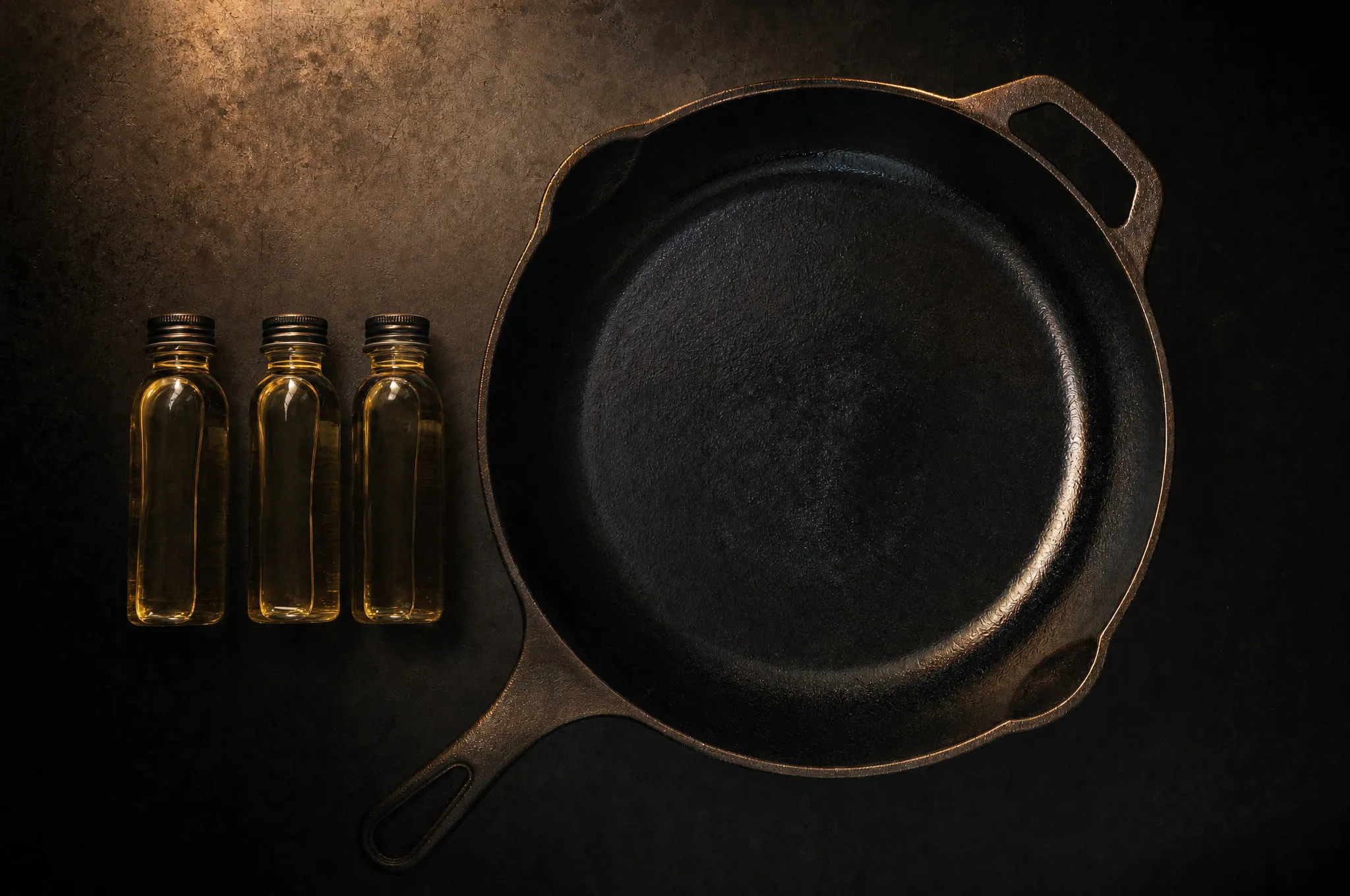
The best oil for seasoning cast iron is any neutral oil with a high smoke point, applied so thin the pan looks dry. Grapeseed if you’re buying a bottle for the job. Canola or plain vegetable oil if you’d rather not buy anything. The oil is the least important variable in seasoning — thin coats, real heat, and repetition do the work.
That answer doesn’t sell specialty bottles, which is probably why you don’t read it often. It’s still the true one. Here’s the ranking, what actually decides the result, and the honest story of the most famous seasoning oil on the internet.
The short answer, ranked
- Grapeseed — the workhorse. Neutral, high smoke point, cheap enough that you’ll use it for every oven coat and every post-cook wipe instead of rationing it.
- Canola or vegetable oil — the budget pick, and “budget” is not a knock. Completely fine. If a bottle is already in your pantry, the search is over.
- Refined avocado — the premium pick. Very high smoke point, nothing wrong with it, costs more than the job requires.
- Refined coconut oil or Crisco — the old-timer choice. Solid at room temperature, which makes thin application slightly fussier, but it works and always has.
Flaxseed oil gets its own section below, because it’s the internet’s favorite seasoning oil and the one we won’t recommend. Seasoning waxes and blends get a section too.
| Oil | Approx. smoke point | Verdict |
|---|---|---|
| Grapeseed | ~390–420°F | The default. Buy once, use it for everything. |
| Canola / vegetable | ~400–450°F | Completely fine. The cheapest way to do this right. |
| Avocado (refined) | ~480–520°F | Fine. Run the oven at the top end for it. |
| Refined coconut / Crisco | ~360–450°F | Works. Wipe hard — solid fats smear on thick. |
| Flaxseed | ~225°F | Hard, glassy, brittle. Famous, and we pass. |
Smoke points shift with brand and refinement, so treat those as ranges, not lab values. Every fat on that list hardens properly in a hot oven. The differences you’ll read about online are smaller than the difference between a thin coat and a thick one.
What actually matters (it isn’t the bottle)
Seasoning is oil that has been polymerized — heated past its smoke point in a microscopically thin film until the fat crosslinks into a hard, dry layer bonded to the iron. Any oil in the table can form that layer. Whether it forms well comes down to three things you control with your hands, not your wallet:
- Coat thickness. Thin wins. A thick coat skins over on top while staying liquid underneath, and you get a sticky pan instead of a slick one. This single factor causes more seasoning failures than every oil choice combined.
- Heat. The oven has to get past the oil’s smoke point for crosslinking to happen. 450–500°F covers everything on our list; 350°F covers almost nothing — that’s how you bake a soft, gummy lacquer instead of seasoning.
- Repetition. Two or three oven coats make a foundation. Cooking — especially anything with fat in it — builds the rest. A year of frying does more for a pan than any decision you make in the oil aisle.
The full process, step by step, is in how to season cast iron in the oven.
Grapeseed: the workhorse
If you’re buying one bottle for seasoning duty, buy this one. Grapeseed is neutral, so it leaves no flavor behind. Its smoke point sits comfortably below a 475°F oven, so the bake actually pushes past it and the coat hardens all the way. And it’s cheap enough that you’ll use it generously — for oven coats, for the after-dinner wipe-down, for restorations — instead of treating it like something precious. It’s what we reach for by default.
Canola and vegetable oil: the cheap answer that’s completely fine
Refined, neutral, high smoke point — canola and generic vegetable oil check every box that matters. Decades of home kitchens have built deep black seasoning with nothing else. If the choice is between ordering something special and using the bottle already next to your stove, use the bottle. The pan cannot tell the difference, and neither will you.
Avocado oil: fine, just pricier than the job requires
Refined avocado oil has the highest smoke point on the list, which cuts both ways. It’s great to cook with at high heat. For seasoning, it means a 450°F oven barely crosses its smoke point — so run the oven at 500°F for avocado coats and give them the full hour. If avocado is already your everyday cooking oil, use it and stop thinking about it. Just don’t buy it specially for seasoning; nothing about the result will be better than grapeseed.
Refined coconut and Crisco: the old-timer choice
Before the internet had opinions, pans got seasoned with shortening, and plenty of the smooth black estate-sale pans people chase were built exactly that way. Crisco still works. Refined coconut oil works too — “refined” matters, because virgin coconut oil smokes low and leaves the pan smelling like coconut. The one adjustment: solid fats smear on thicker than you think. Melt a little in a warm pan, then buff it off harder than feels reasonable before it goes in the oven.
The flaxseed story
Every few years the internet crowns a miracle oil, and flaxseed has held the crown longest. The case came from a widely-cited 2010 blog post that treated seasoning as a chemistry problem: flaxseed oil is the food-grade cousin of linseed oil — the drying oil painters and woodworkers use precisely because it hardens into a tough film — so it should build the hardest, slickest seasoning. The logic was clean, the post spread through every forum, and “six ultra-thin coats of flaxseed” became gospel for a decade.
The argument wasn’t wrong about hardness. It was silent about brittleness. The same dense crosslinking that makes a flaxseed finish glassy also makes it inflexible, and a skillet expands and contracts every single time you cook. The well-documented failure mode follows from that: the finish looks flawless for weeks or months, then lets go in sheets — big flakes lifting off mid-meal. It’s one of the most common patterns behind flaking seasoning, and the fix means scrubbing back everything you built.
Count what the hype actually cost people. They stripped healthy pans to bare metal to do it “right.” They spent a weekend on six careful coats, using a refrigerated specialty oil that isn’t cheap and goes rancid if it sits. They watched the showpiece finish flake into their eggs — and then blamed their own technique and started the whole cycle again, because the method was supposedly proven. That loop is what we hold against the recommendation. The failure wasn’t user error. It was baked into the finish.
If you have flaxseed seasoning right now and it’s intact: leave it alone, keep your coats thin, and keep cooking. There’s no need to strip a surface that’s holding. If it’s already shedding, the flaking guide above walks through the scrub-back and rebuild.
Seasoning blends and waxes
The tins and pucks sold as “cast iron conditioner” or “seasoning wax” are usually ordinary high-smoke-point oils, often firmed up with beeswax so the product holds a solid shape. They work. Nothing in them hurts the pan, and the solid format has one genuine advantage: it’s harder to over-apply than liquid oil.
Just be clear about what you’re buying — convenience and a nice tin. There’s no ingredient in the puck that outperforms a thin coat of canola, because the performance was never in the ingredient. If you enjoy the format, use it happily and ignore anyone who scoffs. If you’re choosing between a puck and a bottle of grapeseed, the bottle does more jobs for less money.
The bottom line
Pick a neutral oil with a reasonably high smoke point. Apply it thinner than feels reasonable, bake it hotter than feels reasonable, and then cook in the pan a lot. That’s the entire game. The pan can’t read the label — it only knows how thick the film was and how hot it got.
Grapeseed if you’re buying. Canola if it’s already in the cupboard. Avocado if that’s what you cook with. Crisco if that’s how your family has always done it. All four end in the same place: a dry, satin, dark surface that gets better every time you use it. The rest of the routine that keeps it that way — cleaning, drying, the post-cook wipe — lives in the care section.
FAQ
Can I season cast iron with olive oil?
You can, but it's not the first pick. Extra-virgin olive oil smokes low and tends to bake into a soft, tacky layer instead of hard seasoning. Refined ('light') olive oil behaves better. If it's what's in the house, use it extra thin with a hot oven — but a neutral oil does the same job with less fuss.
Is flaxseed oil bad for cast iron?
It isn't harmful, and it genuinely produces a hard, glassy finish. The problem is durability: that finish is brittle and has a well-known habit of flaking off in sheets after weeks or months of cooking. If your flaxseed seasoning is intact and holding, keep cooking on it. If you're choosing an oil today, choose grapeseed or canola instead.
Can I season cast iron with lard or bacon grease?
Yes — animal fat is the original seasoning, and a pan that gets cooked in regularly does fine on it. The catch is storage: animal fats can go rancid on a pan that sits unused for weeks. Use them freely as cooking fats that build seasoning; for dedicated oven coats, a neutral oil keeps things simple.
Are cast iron seasoning waxes and blends worth buying?
They work fine. Most are ordinary high-smoke-point oils, sometimes firmed up with beeswax, sold in a tin. You're paying for convenience and packaging, not performance — a thin coat of canola hardens into the same seasoning. If you like the solid format, there's no reason to feel bad about using it.