Care 7 min read
Cast Iron Seasoning Flaking Off? Why It Peels and How to Fix It
Flaking seasoning is a failed bond — coats too thick, oil over residue or rust, or brittle flaxseed. Why it peels, whether flakes are safe, and how to fix it.
This guide has product links. As an Amazon Associate, Seasoned Cast earns from qualifying purchases — it never changes what we recommend.
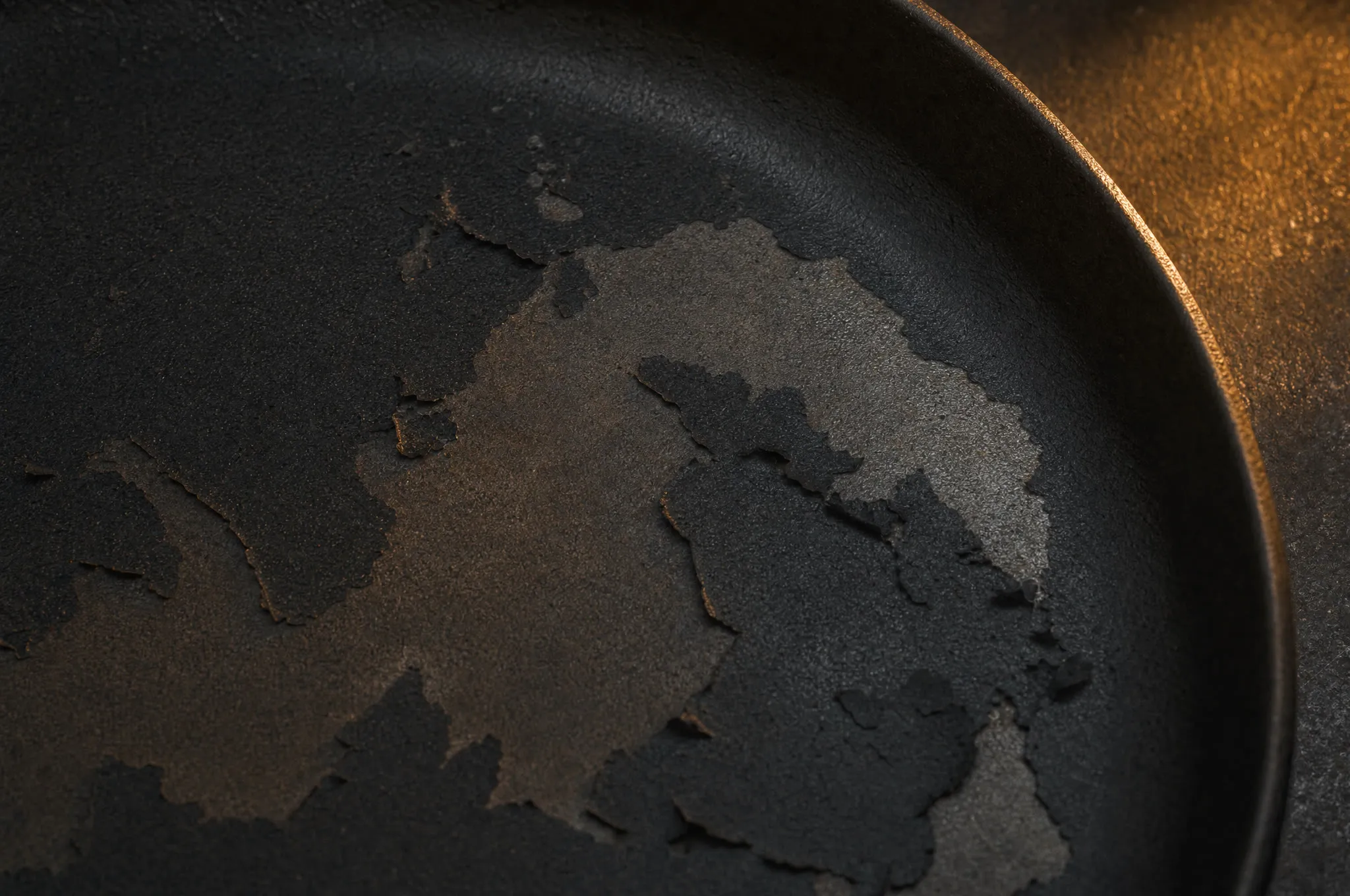
Seasoning flakes off when its bond to the pan fails — usually because coats went on too thick and stacked up like paint, or because oil was baked over residue or rust it could never grip. The flakes are carbonized oil, not metal, and they won’t hurt you. Scrub off everything loose, then re-season thin over the layers that held.
Flaking completes cast iron’s troubleshooting trio. A sticky pan is oil that never hardened. A smoking pan is usually oil burning off the surface. A flaking pan is seasoning that hardened just fine and then let go of the iron. Here’s how to read the flakes, and the fix for each level of damage.
Read the flakes before you fix anything
Not all flaking is the same problem. Tip the pan under a good light and look at what’s coming off — and at what’s underneath it.
| What you see | What it is | What to do |
|---|---|---|
| A few black specks in food, usually after tomato sauce or a long simmer | Normal wear on a young seasoning | Fish them out, keep cooking, wipe with oil after |
| Hard flakes lifting off the cooking surface, dull gray underneath | Coats built too thick, too fast | Scrub off everything loose, re-season thin |
| Glassy sheets peeling like old paint | Brittle seasoning — flaxseed’s signature failure | Scrub back hard, or strip and start over |
| Flakes with orange or brown on the underside | Seasoning laid over rust — it never had a grip | Remove the rust first, then season from clean metal |
The first row isn’t damage. Acidic food works on the newest, weakest seasoning and lifts a speck or two; most pans do it early in their life. The other three rows mean part of the stack has failed, and the fix depends on how much.
Why seasoning flakes
Seasoning is oil polymerized into a hard film, and that film only stays put if every layer bonded fully to whatever was under it — the iron, or the cured layer below. Four things break that bond, and they account for nearly every flaking pan:
- Coats built too thick, too fast. Thick coats stack like paint. Each one skins over before it cures all the way through, so you end up with a slab that’s hard on top and weak in the middle. Heat cycles flex the pan, the weak middle gives, and the slab lets go in chips. This is the same over-oiling mistake that makes a pan sticky — stickiness is that failure showing up early, flaking is the same failure showing up months later.
- Seasoning over residue or rust. Oil bonds to clean iron or to sound seasoning. It does not bond to carbon crud, old grease, or rust — it bonds to the top of them, and when they let go, the new seasoning rides along. A coat baked over a dirty or rusty surface was loose the day it went on; it just hadn’t fallen off yet.
- Flaxseed oil. Flaxseed is a drying oil, and it cures into the hardest, glassiest seasoning finish there is. It’s also the most brittle, with a well-earned reputation for looking perfect for months and then releasing in sheets. If your pan was seasoned with flaxseed and is now shedding, nothing went wrong with your technique — that’s the trade the oil makes.
- Thermal shock. Iron swells as it heats and shrinks as it cools. Run a screaming-hot pan under the cold tap and it shrinks fast — faster than the seasoning riding on it. The bond pops, sometimes in patches you won’t notice until they turn up in dinner. In the worst case the shock cracks the pan itself, and a crack is forever.
If flakes end up in your food
They’re safe. Seasoning flakes are carbonized oil — the same polymer the rest of the cooking surface is made of, just detached. Eating a fleck is unpleasant and slightly bitter, not dangerous. Fish out what you can, eat the meal, and don’t throw good food away over it.
The flakes are a message, not a hazard. Every spot that sheds leaves bare iron behind; bare iron sticks and rusts, and the loose edges around each bare patch are next in line to let go. No emergency — but fix the pan this week, not this year.
Light flaking: scrub the loose stuff, patch it thin
If the flaking is limited to a patch or two and the rest of the surface is dark, smooth, and tight, don’t strip anything. Repair over the survivors.
- Scrub the flaking areas with a chainmail scrubber and hot water, working until nothing new lifts. You’re trying to knock off every layer that’s willing to go — better on the scrubber now than in the eggs later. Soap is fine. Keep going past the point where it feels done: the edges around each flaked patch are the weakest seasoning on the pan.
- Rinse, then dry the pan on a burner over medium heat until it’s fully dry and too hot to touch. Water sitting in bare-iron patches becomes rust overnight.
- Re-season with two or three thin oven coats — wipe oil on, wipe it all off, bake upside down, cool, repeat. The full routine is in how to season cast iron in the oven. The repaired patches will look lighter than the rest of the pan for a few weeks; regular cooking evens them out.
Sheet-flaking everywhere: go back to something solid
When seasoning is releasing across most of the surface — sheets, not specks — patching is wasted work. New seasoning is only as strong as what it sits on, and what it would sit on here is a stack that’s already failing. Two ways down:
- Scrub back hard. Chainmail, hot water, real pressure, the whole surface. Take off everything that will come off, even if the pan ends up blotchy and mostly gray. Whatever survives that treatment is bonded well enough to build on. Then run a full oven-seasoning course over it.
- Strip to bare metal. If the whole stack is suspect — a flaxseed pan shedding sheets, a garage-sale pan with unknown history, rust showing under the flakes — take it all the way down and start over. A lye bath dissolves every trace of old seasoning without touching the iron, and an electrolysis tank handles any rust on top of it. Either one turns a failing pan into a factory-fresh start for the cost of a weekend.
Keeping it from coming back
- Thin coats, always. Wipe the oil on, then wipe it off like you regret applying it. A correctly oiled pan headed for the oven looks like nothing happened to it. Thick coats are how the paint-stack failure starts, and no choice of oil fixes a thick coat.
- Build slowly. Two or three oven coats make a working base; cooking builds the rest. Ten oven coats in a weekend make a thick young stack that hasn’t earned its hardness — exactly the slab that flakes.
- Feed a new seasoning fat, early. For the first few weeks after seasoning, cook bacon, sausage, fried potatoes, cornbread — fatty, gentle food that adds to the surface every time. Hold the tomato sauce and the wine braise until the surface has gone dark and even; acid works on young seasoning harder than anything else in the kitchen.
- Never quench a hot pan. Cooking done, pan waits. Let it cool on the stovetop until it’s merely warm before it sees water. This one habit removes thermal shock from the list entirely.
- Keep the 60-second post-cook routine. Wash, dry on the burner, wipe in a drop of oil, buff until the pan looks dry. The whole rhythm lives in the care section.
Flaking looks like the pan giving up, and it’s the opposite: it’s the old mistake leaving. The thick coats, the seasoning-over-crud, the flaxseed experiment — all of it exits as flakes, and what stays behind holds. Scrub off everything loose, season thin over what survived, cook something fatty this week, and the surface that grows back will be the one that doesn’t peel.
FAQ
Are black flakes from cast iron safe to eat?
Yes. Seasoning flakes are carbonized oil — the same hardened polymer the rest of the surface is made of, just detached. A fleck in the food tastes bitter and does no harm; fish it out and eat the meal. Treat the flakes as a maintenance signal, though: every one leaves a bare spot that will stick and rust if it's ignored.
Do I need to strip the whole pan if seasoning is flaking?
Only if the flaking is widespread. A patch or two means scrub off the loose material and re-season thin over the stable layers — an evening's work. Sheets releasing across most of the surface, or rust showing underneath, means the stack itself has failed: scrub back hard to whatever holds, or strip to bare metal and start clean.
Why does flaxseed oil seasoning flake off?
Flaxseed is a drying oil. It cures into the hardest, glassiest finish of any common seasoning oil — and the most brittle. The pattern is well known: it looks flawless for months, then releases in sheets. A boring neutral oil applied thin never gets that glassy, but it wears down gradually instead of shattering off, which is the better trade for a pan you cook in.
Can I keep cooking on a pan with flaking seasoning?
You can — the flakes aren't a health hazard. But every flake leaves bare iron that sticks and rusts, and cooking keeps working on the loose edges, so the problem grows. A chainmail scrub and a couple of thin oven coats cost an evening and stop it cold. Fix it soon rather than cooking around it.