Cook 7 min read
Cast Iron Cornbread Without Buttermilk (What to Use Instead)
Sour milk with lemon or vinegar, thin plain yogurt, or use plain milk and adjust the leavening — why each works, and the hot-skillet pour that makes the crust.
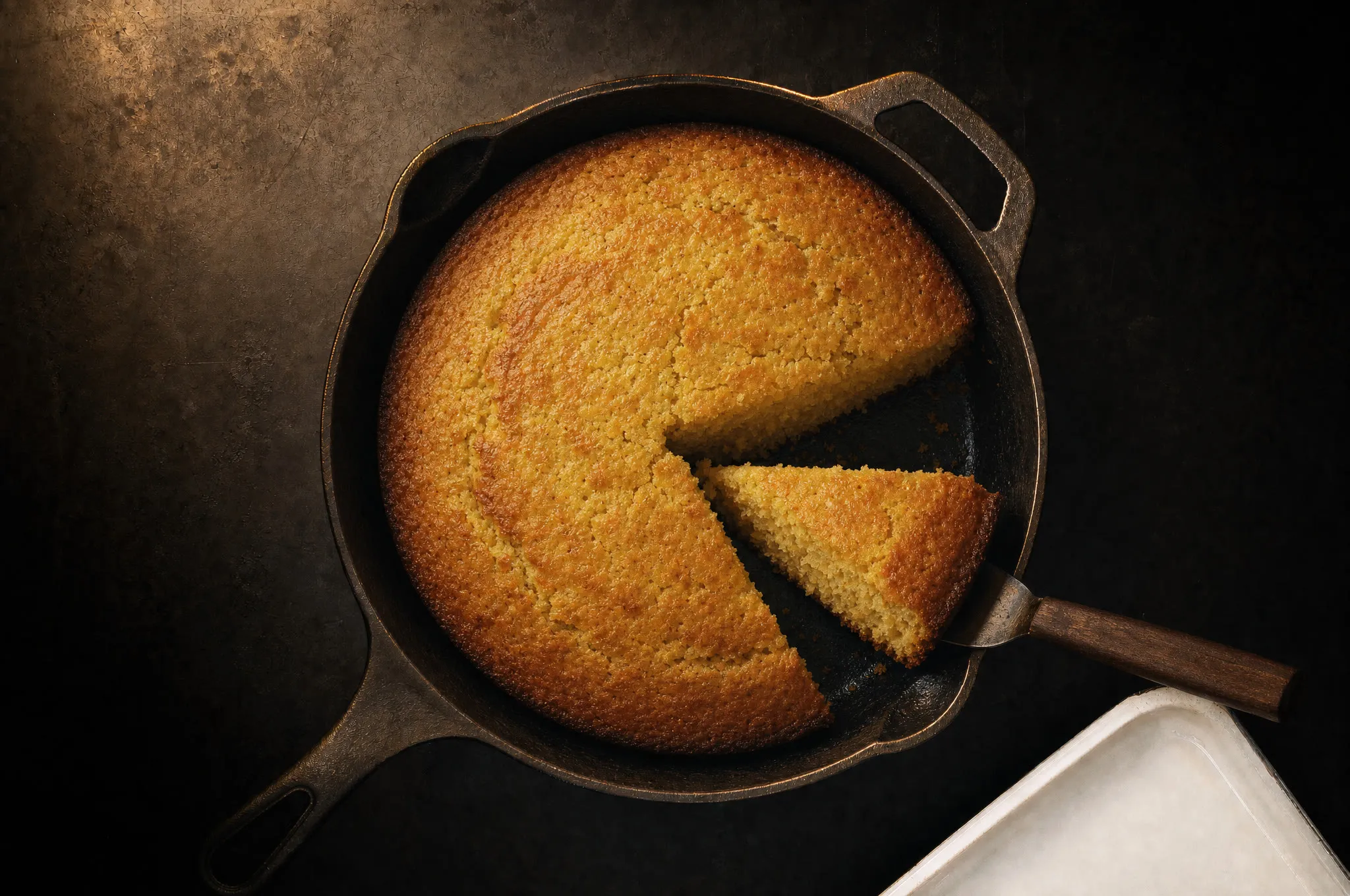
Three substitutions work: stir one tablespoon of lemon juice or white vinegar into a cup of milk and let it stand five to ten minutes; thin plain yogurt with milk until it pours; or use plain milk and swap the baking soda for extra baking powder. Pour any of them into a screaming-hot, fat-slicked skillet and you get real cornbread.
The substitution is the easy half. The crackling crust — the part that makes skillet cornbread worth writing about — never came from the buttermilk in the first place. It comes from preheating the pan, and that technique is most of this page. Same heat logic as everything else in the Cook section: charge the iron first, then let it work.
What buttermilk actually does
Substitutions make sense once you know what you’re replacing. Buttermilk holds three jobs in a cornbread batter:
It fires the baking soda. Soda is an alkali; it produces lift only when it meets an acid. Buttermilk is that acid. Together they throw off carbon dioxide the moment the batter mixes, and the hot oven locks that rise in place.
It tenderizes. The same acid slows gluten development in the flour, which keeps the crumb tender instead of bready.
It brings the tang. That faint lactic sourness is a good part of what reads as “cornbread flavor” against the sweetness of the corn.
So a real substitute needs acid, roughly the same amount of liquid, and ideally some of that fermented flavor. Here’s how the three options stack up.
The three substitutions, ranked
Milk plus acid — the workhorse. One tablespoon of lemon juice or distilled white vinegar per cup of milk. Stir, then let it stand five to ten minutes while you measure everything else. It will thicken slightly and curdle faintly at the edges — that’s the acid doing its job, not the milk going wrong. It’s thinner than buttermilk, which is fine, and neither lemon nor vinegar survives baking as a flavor. This is what we use nine times out of ten, because milk and vinegar are always in the house.
Plain yogurt, thinned — the closest match. About three-quarters of a cup of plain yogurt whisked with a quarter cup of milk replaces a cup of buttermilk. Yogurt brings acid and thickness and actual fermented tang — the full job description. Whole-milk yogurt is best; Greek yogurt works but needs more milk to reach a pourable batter. If you have it, use it.
Plain milk with adjusted leavening — the honest fallback. No acid at all, so the baking soda has nothing to react with — left in, it sits there unfired and tastes soapy and metallic. Drop the soda entirely and raise the baking powder to a full tablespoon; baking powder carries its own acid and doesn’t need the milk’s help. You lose the tang and a little tenderness. You lose nothing off the crust, because the crust was never the buttermilk’s work.
The technique that is the article: preheat the skillet
Here is the part that separates skillet cornbread from cornbread that happens to be in a skillet. The pan goes into the oven with the fat already in it while the oven preheats. By the time the batter is mixed, the fat is shimmering — right at the edge of smoking — and the iron is charged with more heat than any baking pan can hold.
Pour the batter into that hot fat and it doesn’t sit down politely. It sizzles. The outer quarter inch starts frying on contact, the edges set before the batter can creep up the walls, and twenty minutes later you turn out a loaf with a deep brown, crackling, faintly fried crust that no cold-started pan — metal, glass, or otherwise — can replicate. This is cast iron’s whole argument: a reservoir of stored heat, spent all at once on a cold batter.
A tablespoon or two of fat is all it takes. Bacon fat is the classic and tastes like it. Neutral oil works fine. Butter brings the best flavor but its milk solids can burn during a long preheat — use half butter, half oil, or add the butter for the last few minutes only.
The recipe
Sized for a 10-inch skillet. This is the even-split version — half cornmeal, half flour, a little sugar — which is a northern ratio, and we’ll say so plainly. If your cornbread church is southern, run one and a half cups cornmeal to a half cup of flour and cut the sugar to a teaspoon or none. The skillet technique doesn’t care; both batters fry the same.
Ingredients
- 1 cup yellow cornmeal, fine or medium grind
- 1 cup all-purpose flour
- 1–2 tablespoons sugar (see the note above)
- 2 teaspoons baking powder
- ½ teaspoon baking soda (using plain milk? skip this — baking powder goes to 1 tablespoon)
- 1 teaspoon fine salt
- 1 cup milk + 1 tablespoon lemon juice or white vinegar (or ¾ cup plain yogurt thinned with ¼ cup milk, or 1 cup plain milk with the leavening change)
- 2 large eggs
- 4 tablespoons butter, melted, or neutral oil (for the batter)
- 1–2 tablespoons bacon fat, oil, or butter-and-oil (for the skillet)
Method
- Stir the lemon juice or vinegar into the milk and let it stand 5–10 minutes while you measure the rest. Slightly thickened, faintly curdled — that’s ready. (Yogurt route: whisk yogurt and milk smooth instead.)
- Put the skillet fat in the 10-inch pan, set it on the middle rack, and preheat the oven to 425°F. Pan and oven heat together.
- Whisk the dry: cornmeal, flour, sugar, baking powder, soda, salt.
- Whisk the wet: soured milk, eggs, melted butter.
- Fold wet into dry until just combined. Small lumps are fine; overmixing builds gluten and toughens the crumb.
- Pull the skillet when the fat shimmers or shows its first wisp of smoke. Swirl to coat, then pour the batter into the center. Listen for the sizzle.
- Bake 20–25 minutes at 400–425°F, until the top is golden, the edges have pulled from the wall, and a toothpick in the center comes out clean.
- Rest 5 minutes in the pan, then run a thin spatula around the edge and turn it out onto a rack or board. Left in the pan, that crust steams itself soft — get it out.
Skillet size, briefly
This batch fits a 10-inch skillet like it was born there. In a 12-inch, it bakes thinner and faster — start checking at 15 minutes — and every slice carries more crust, which some people count as a win. An 8-inch runs taller; give it five extra minutes. If you’re buying your first pan and cornbread is on the list, the sizing logic is in our beginner skillet guide.
Why cornbread loves a young pan
If your skillet is new — factory seasoning, first few cooks — cornbread is close to the perfect assignment. The preheat bakes a coat of hot fat onto every inch of the cooking surface, which is functionally a mini seasoning pass. The batter itself is rich with butter and eggs, nothing simmers long enough to stress the finish, and the bread releases clean. It’s a seasoning session that produces dinner. We put it on the short list of first cooks for a pre-seasoned pan for exactly this reason.
And no, the soured milk doesn’t undo any of that — see the FAQ below. A briefly acidic batter that sets in the oven within minutes is not the acid problem the warnings are about.
Aftercare
Cornbread nights are the easy ones. Turn the loaf out, let the pan cool off its peak, and there’s usually nothing in it but crumbs and a gloss of fat. Wipe it out; wash it if it needs washing; dry it on a burner until bone dry; wipe in two or three drops of oil and buff until it looks dry again. The whole routine, with the reasoning, lives in the care section.
That’s the move. Sour the milk with lemon or vinegar, or thin some yogurt, or lean on baking powder alone — the batter forgives all three. What it won’t forgive is a cold pan. Preheat the skillet with the fat until it’s just short of smoking, pour, listen for the sizzle, and the crust takes care of itself.
FAQ
Can I use regular milk instead of buttermilk in cornbread?
Yes, with one adjustment: baking soda needs acid to fire, and plain milk has none. Skip the soda and use a full tablespoon of baking powder instead. You give up a little tang and a slightly tender crumb — nothing else. The crust comes from the hot skillet either way.
How long should milk and lemon juice sit before it can replace buttermilk?
Five to ten minutes at room temperature — one tablespoon of lemon juice or white vinegar stirred into one cup of milk. It thickens slightly and curdles faintly at the edges. It never gets as thick as real buttermilk and doesn't need to; the acid is what the recipe is waiting for.
Why does the skillet go in the oven before the batter?
Crust. Batter poured into hot fat starts frying on contact, which builds the deep brown, crackling bottom and edges cornbread is famous for. A cold skillet gives you pale, steamed edges instead. The hot pan also sets the batter fast, so the leavening pushes the bread up instead of letting it spread out.
Will soured milk or yogurt in the batter hurt my seasoning?
No. The batter is mildly acidic at most, buffered by fat, eggs, and starch, and the oven sets it within minutes. The acid warnings you've read are about tomato sauce simmering for an hour on young seasoning — not a quick batter. Cornbread is one of the friendliest things you can cook on a new pan.