Restore 7 min read
How to Fix Warped Cast Iron (Honest Answer: You Usually Can't)
Most warped cast iron can't be safely flattened — trying often cracks the pan. How to check for warp, what causes it, and what a warped pan is still good for.
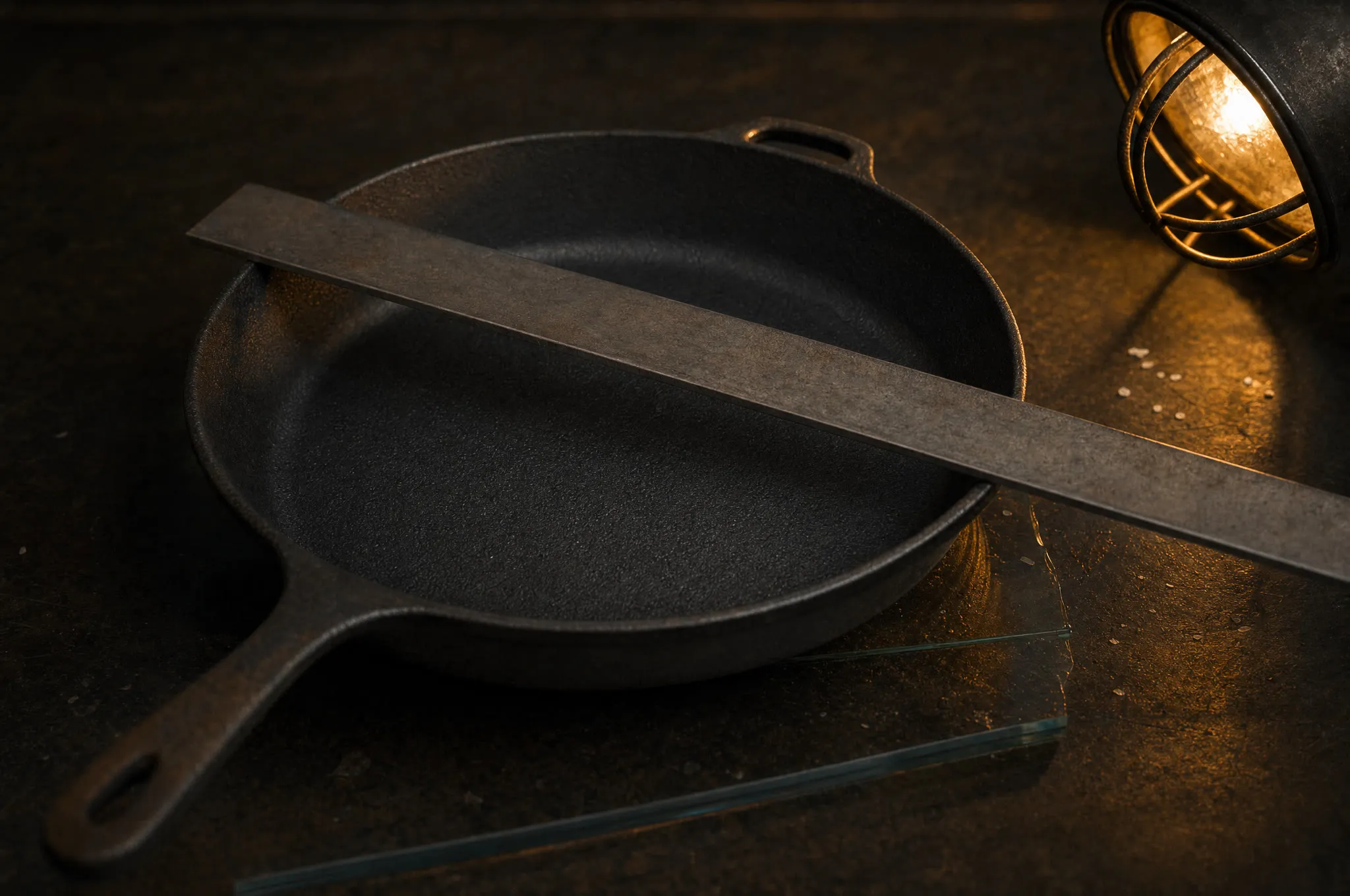
Most warped cast iron can’t be fixed, and most attempts to fix it end in a cracked pan. Cast iron is brittle — it doesn’t bend back the way steel does; it fractures. The honest move is to confirm the warp, figure out what caused it, and decide whether the pan still earns a spot on your stove. More often than you’d think, it does.
That’s a different answer than you’ll get from most of the internet, so let’s earn it: how to check, why the pan moved, why the “fixes” are a bad bet, and what to do instead.
How to check for warp
You need one flat surface and thirty seconds. A glass stovetop, a stone or quartz countertop, or a sheet of glass all work. A wood table doesn’t — wood isn’t flat enough to trust.
- The rock test. Set the pan right-side up on the flat surface and press down on the rim at 12, 3, 6, and 9 o’clock. Any clunk or rocking means the bottom isn’t flat.
- The spin test. Give the pan a gentle twist. A flat pan drags and stalls. A pan that spins like a lazy Susan has a convex bottom — a “spinner,” and the worst version of warp for stovetop cooking.
- The straightedge. Lay a metal ruler or any true straightedge across the cooking surface, then across the underside, and look for daylight under it. A gap in the middle of the cooking surface means the pan is dished and oil will run to the walls. A hump means it will pool at the edges instead.
A pan that passes all three is flat. A pan that fails by a hair is normal — plenty of working cast iron, especially vintage, carries a slight warp and cooks fine on the right burner. A pan that visibly rocks or spins freely has a real problem on any smooth cooktop.
How pans warp in the first place
Iron expands when it heats and shrinks when it cools. Warp happens when one part of the pan does that violently while another part doesn’t — the metal fights itself, something gives, and the pan takes a new shape.
Two situations cause nearly all of it:
- Thermal shock. A screaming-hot pan hits cold water in the sink. The quenched spots contract instantly while the rest of the pan is still expanded, and the stress has to go somewhere. This is the classic one-second mistake that permanently moves a pan — and sometimes cracks it on the spot.
- Uneven high heat. A pan hanging half off a small burner on max, or an empty pan preheated on high until it smokes, heats one zone far faster than the rest. Thin vintage pans are especially vulnerable — the old Griswolds and Wagners are loved for their light, machined-smooth build, but thin iron has less mass to buffer abuse. Modern thick castings shrug off heat that will move a ninety-year-old pan.
Some pans also arrive slightly out of flat from casting stresses and decades of heat cycles. Nobody abused them; iron just moves over a century of fires.
Why the online “fixes” are a bad bet
Search this topic and you’ll find two families of fix: press the heated pan flat under weight, or work the warp out with a hammer against a solid backing. We’re not going to teach either one, and here’s the honest reason why.
Cast iron is not sheet steel. It’s a brittle, high-carbon casting with almost no ability to stretch at any temperature you can reach at home. Steel bends and takes the correction; cast iron resists, resists, and then cracks — often with no warning between “not moving” and “broken.” The people who genuinely flatten cast iron do it at foundry temperatures with machinery, not in a garage with a bottle jack.
There’s a quieter reason too: even the success stories often don’t last. The stresses that pulled the pan out of flat are still living in the metal, and a few normal heat cycles can walk it right back to where it was. You’d be risking a crack for a temporary fix.
What a warped pan is still good for
This is the part most articles skip, and it’s the actual answer for most people. Warp only matters where the pan needs flat contact with a flat, smooth surface.
- Gas burners barely care. Flame wraps the bottom of the pan whether or not it’s touching anything. A slight warp on gas mostly shows up as oil drifting to one side — tilt the pan or nudge the food, and dinner proceeds.
- The oven doesn’t care at all. Cornbread, roasted vegetables, a finished steak, deep dish — oven heat is air heat, and contact is irrelevant. A badly warped skillet makes a perfectly good baking pan for the rest of its life.
- Camp cooking doesn’t care either. Coals and open fire treat a warped pan exactly like a flat one.
The place warp genuinely hurts is a smooth cooktop. Radiant glass-tops and induction both need the pan bottom flat against the glass to transfer heat, so a warped pan cooks weakly and unevenly there — and a spinner adds insult by rotating every time you stir, dragging its high spot across the glass as it goes. If that’s your stove, the full picture is in our guide to cast iron on a glass-top stove, but the short version is blunt: a spinner is effectively retired from a glass cooktop. No burner setting fixes geometry.
When to retire a pan
- Any crack, anywhere: immediately. Heat cycling grows cracks, and a cracked pan can fail in use. It’s done — no exceptions.
- A spinner on a glass-top-only kitchen is done as a stovetop pan. Demote it to oven and campfire duty, or hang it.
- A rocker that annoys you every time you cook is allowed to retire too. Old iron makes a genuinely good-looking wall piece, and a warped skillet still works as a lid, a trivet, or the pan that lives with the camping gear.
Retirement isn’t failure. A pan that baked cornbread for ninety years and finishes its run holding down the top of a dutch oven had a good career.
Prevention: one rule and a habit
The rule: no cold water in a hot pan. Ever. This single sentence prevents most warp (and most cracks). Let the pan cool on the stovetop until you can rest a hand near the metal, then wash it. If you need to deglaze stuck bits, use warm water while the pan is still just moderately hot — not a cold rinse on screaming iron.
The habit: gentle preheats. Start the burner at medium-low and give the pan a few minutes to come up as one piece of metal instead of one hot zone. Match the pan to a burner close to its size. And don’t run thin vintage iron on max — it will do everything you need at medium and last longer for it.
Check before you buy
Warp prevention starts at the flea market. Before money changes hands, set the pan on the flattest surface you can find, press the rim, spin it, and sight down the rim from the side. Sellers rarely mention warp; plenty don’t know their pan is a spinner.
Keep the priorities straight when you’re judging old iron: rust is fixable — it scrubs off and the pan underneath is usually fine — but warp is forever. A crusty, orange, flat pan is a project; a shiny, clean spinner is a wall hanging. If you’re weighing old versus new in the first place, our Lodge vs. vintage breakdown covers when a thin old pan is worth the hunt and when a thick modern casting is the smarter buy.
A warped pan isn’t the end of anything — it’s a pan with a narrower job description. Give it the burner or the oven duty it can still do well, hold the line on the cold-water rule with everything else you own, and if the pan needs more help than that, the Restore section covers everything that actually can be brought back.
FAQ
Can a warped cast iron pan be fixed?
Usually not. Cast iron is brittle — it fractures instead of bending, so the press and hammer methods that circulate online carry a real risk of cracking the pan outright. Even when they appear to work, the pan often creeps back out of flat with normal heat cycles. The practical fix is deciding where a warped pan still works: gas burners, the oven, and the campfire all forgive it.
Is it safe to cook on a warped cast iron pan?
Yes. Warp is an evenness and stability problem, not a safety problem — oil pools to one side, sears come out patchy, and the pan may rock or spin on a flat cooktop. The thing that is unsafe is a crack. Cracks grow with every heat cycle, and a cracked pan can fail with hot fat in it. Warped pans keep cooking; cracked pans retire.
Why do vintage pans warp more than modern ones?
Vintage pans from makers like Griswold and Wagner were cast thin and machined smooth, which is exactly why collectors love them — they're light and slick. But thin iron has less mass to absorb uneven heating, so a screaming-hot burner or a shot of cold water moves it more easily. Thick modern castings like Lodge tolerate abuse better; they're just heavier for it.
Will a slightly warped pan work on an induction cooktop?
Poorly. Induction needs the pan bottom close to the glass to couple with the coil, so a belly or a rocking pan heats weakly and unevenly, and a spinner rotates every time you stir. Same story as radiant glass-tops: flat-bottomed pans only. A gas flame is the forgiving option if you want to keep cooking on warped iron.