Buying 7 min read
Cast Iron Accessories Worth Buying (It's a Short List)
Most cast iron accessories are padding. A chainmail scrubber, instant-read thermometer, handle cover, stiff brush, and grapeseed oil earn a spot — skip the rest.
This guide has product links. As an Amazon Associate, Seasoned Cast earns from qualifying purchases — it never changes what we recommend.
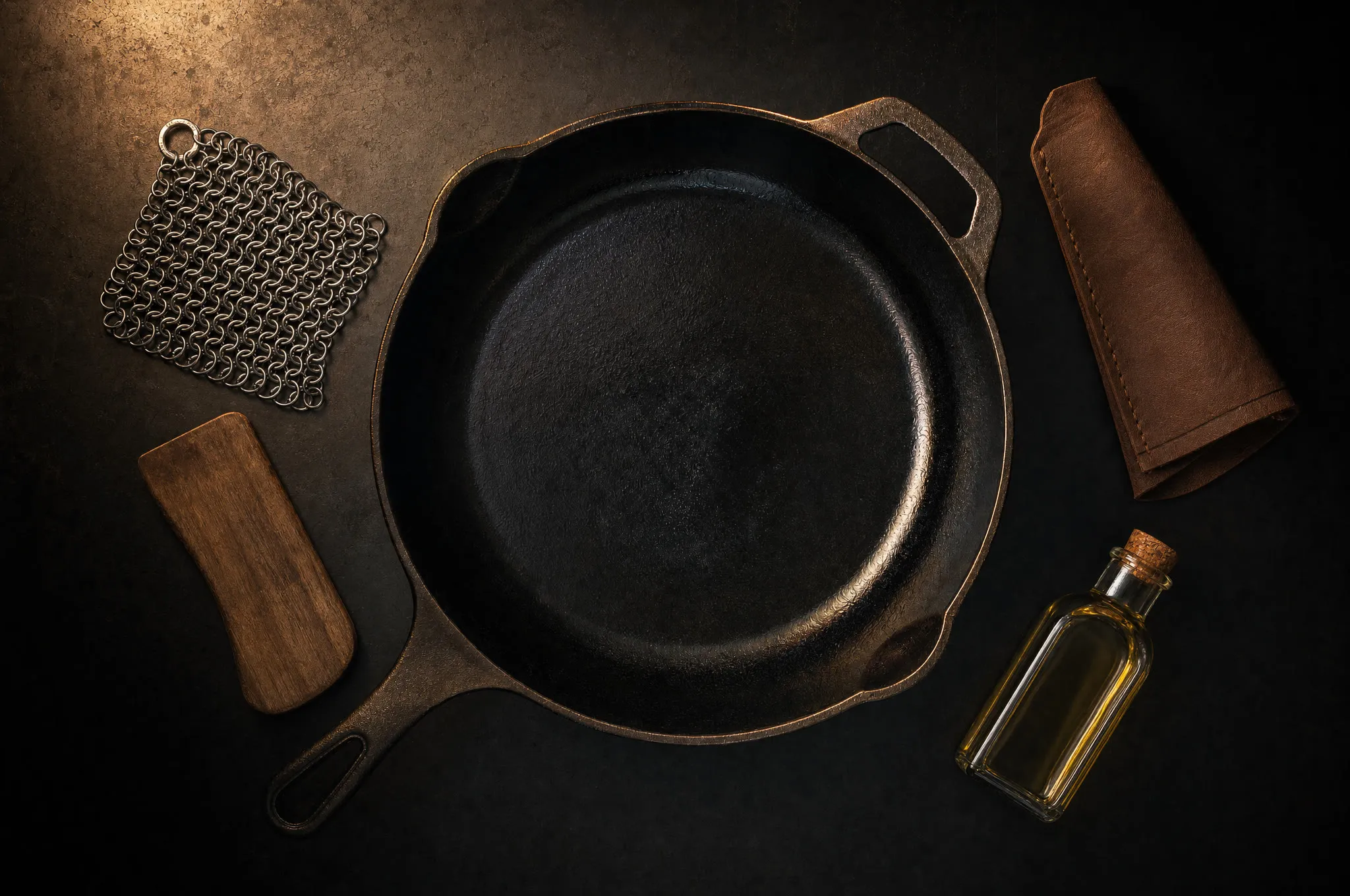
Most cast iron accessories are junk. Five earn a place: a chainmail scrubber, an instant-read thermometer, a handle cover, a stiff brush or wooden scraper, and a bottle of grapeseed oil. Everything else on the “essential cast iron kit” lists is padding — the pan itself doesn’t want gadgets.
Here’s the problem with cast iron as a business: the pan never wears out. Nobody makes money selling you a second skillet, so the money moves to the accessory aisle — and that’s why every “essential kit” list runs fifteen items deep. It isn’t fifteen items deep. It’s five, and one of the five is oil. Below is each one and the honest reason it earns drawer space, followed by the stuff you can leave on the shelf. The rest of our buying guides work the same way.
Chainmail scrubber: the one essential
Cleanup is where cast iron ownership lives or dies. Pans don’t get abandoned because they cook badly — they get abandoned because scrubbing stuck-on food every night stops being charming. A sponge glides over baked-on fond without moving it. Steel wool moves it, along with the seasoning you spent months building. Chainmail is the tool that splits the difference: the rings knock crud loose while riding over the hard polymerized layer underneath, so the pan comes clean without going backward.
It’s also close to a lifetime purchase. There’s nothing to wear out, nothing to sour in the sink, and it rinses clean in seconds. Ring-only mats and silicone-core versions handle slightly differently — the full breakdown is in our chainmail scrubber guide — but any of them beats everything else in the sink caddy. If your budget for accessories is one item, this is the item.
Instant-read thermometer
Not a cast iron accessory, strictly speaking — and that’s exactly why it makes the list over a dozen things that are. Cast iron’s defining trait is heat mass: the pan gets hotter than other pans and stays hot longer. That’s what makes searing a steak work, and it’s also what shrinks the window between perfect and overcooked. Guessing doneness on a surface that hot is how a medium-rare steak goes gray in the ninety seconds you spent finding the tongs.
A fast probe thermometer ends the guessing. Steak comes off at the number instead of the vibe, chicken stops being a coin flip between undercooked and sawdust, and fry oil gets checked instead of eyeballed. It improves every cook on every pan you own, which is a better return than any single-purpose gadget on the “essentials” lists.
A handle cover, silicone or leather
The classic cast iron burn isn’t dramatic. The pan comes off the burner, dinner gets plated, and five minutes later you grab the handle bare-handed — because every other pan in the house has a handle that stays cool, and your hand has learned that lesson too well. Cast iron’s handle is the pan. Same iron, same temperature, and it holds that temperature long after the stove is off.
Honesty requires saying a folded dry towel does this job for free. The cover earns its spot anyway, for two reasons. First, it lives on the pan or next to it, so it’s there at the moment the towel isn’t. Second, kitchen towels have a habit of being slightly damp, and a damp towel on a hot handle turns to steam against your palm instantly. A silicone sleeve stays put through stovetop work; a leather slip-on looks better and doubles as a grab pad. Either way, take it off before the pan goes in the oven — silicone ratings vary and leather scorches.
A stiff brush or wooden scraper
This is the everyday tool. Most nights, cleanup is hot water and thirty seconds of brushing — the chainmail only comes out when something actually stuck. A stiff-bristle dish brush moves grease and loose bits fast, keeps your fingers out of the mess, and gets into the corner where the wall meets the floor of the pan. A flat-edged wooden scraper pops the stubborn spots the bristles skate over; the wooden spatula you cooked with does the same job if it has a decent edge.
One of each covers every cleanup a skillet can produce, and either one alone covers most of them. Pair it with the two-minute dry-and-wipe routine — that full loop lives in the care section — and the “cast iron is high maintenance” reputation stops making sense.
Grapeseed oil
The one consumable on the list. A dedicated bottle by the stove is what makes the maintenance routine real: the thin wipe after cleanup, the occasional oven coat, the restoration work when a garage-sale pan follows you home. Any neutral, high-smoke-point oil does the job — the full ranking explains why the bottle matters less than the technique — and grapeseed is the pick if you’re buying one on purpose: neutral, high smoke point, cheap enough that you’ll use it freely instead of rationing it. An oil you ration is an oil you skip, and the skipped wipe-down is how seasoning erodes.
Skip these
Everything below shows up on the standard “cast iron essentials” list. None of it earns the space.
Seasoning waxes sold as magic. The puck itself is fine — ordinary high-smoke-point oil firmed up with beeswax, and we’ve said as much in the oil guide. What you should skip is the pitch: secret formulas, instant restoration, seasoning your pan “the right way.” There is no ingredient in the tin that outperforms a thin coat of the grapeseed you already bought. If you happen to like the solid format, enjoy it. Just don’t buy it believing it does something oil can’t, because the performance was never in the ingredient.
Pan scraper multipacks. The pitch is a scraper for every corner radius. The reality is you need one scraping edge, and the other five live in a drawer until you move house. A single scraper — or the edge of a wooden spatula, which you already own — does the entire job. If one comes bundled free with a chainmail scrubber, keep it and call the category finished.
Cast-iron-specific soap. Modern dish soap doesn’t strip seasoning — that fear dates from the era of lye-based soap, and it’s been obsolete for generations. The special “cast iron soap” in the rugged tin is regular soap wearing a lumberjack label. Use the dish soap at your sink, or use plain hot water. Either way, this product solves a problem you don’t have.
Glass lids you’ll never use. Skillet-specific lids get bought for an imagined future of braises and finished forever in a cabinet, because almost everything a skillet does — searing, frying, roasting, baking — happens uncovered. The rare steam-finish or simmer is covered fine by a lid from a pot you already own, sitting slightly crooked. And if you genuinely braise every week, the honest advice isn’t a lid — it’s a Dutch oven.
The bottom line
The test for a cast iron accessory is weekly use. The chainmail scrubber, the brush, the handle cover, and the oil pass because they’re part of how the pan gets used and cleaned every single week. The thermometer passes because it makes the food better every time the pan gets hot. Everything else in the accessory aisle fails that test for most cooks, no matter how at-home it looks in the product photos.
Buy the five, skip the rest, and put the savings toward meat worth searing. The pan doesn’t want gadgets — it wants heat, fat, and repetition, and the care routine that keeps a five-item kit doing the work of fifteen.
FAQ
Do I really need a chainmail scrubber for cast iron?
It's the one accessory we'd call essential. Stuck-on food is the daily reality of cast iron cooking, and chainmail clears it in seconds without chewing up the seasoning the way steel wool does. One scrubber outlasts a drawer full of sponges. If you buy exactly one thing for your pan, buy this.
Are cast iron accessory kits and bundles worth it?
Usually not. Most bundles pair one genuinely useful item — typically the chainmail scrubber — with filler: scraper multipacks, branded soap, a flimsy brush. You pay for a box of things that end up in a drawer. Buy the scrubber on its own and add other tools only when a real need shows up.
Do I need special soap for cast iron?
No. Modern dish soap doesn't strip polymerized seasoning, so a few drops on a well-seasoned pan is fine. Products sold as cast-iron soap are ordinary soap with a niche label. If soap still makes you nervous, hot water and a stiff brush handle most cleanups anyway.
Should I buy a lid for my cast iron skillet?
Only if you already know what you'll cook under it. Most skillet work — searing, frying, roasting — happens uncovered, and a lid from a pot you already own fits well enough for the occasional steam or simmer. Skillet-specific glass lids are a classic regret purchase: bought for a someday braise, stored forever.