Buying 6 min read
The Best Chainmail Scrubber for Cast Iron (the One Accessory That's Actually Essential)
A chainmail scrubber shears stuck food and carbon off cast iron without cutting the seasoning. Get the silicone-core style — here's why, and how to use it right.
This guide has product links. As an Amazon Associate, Seasoned Cast earns from qualifying purchases — it never changes what we recommend.
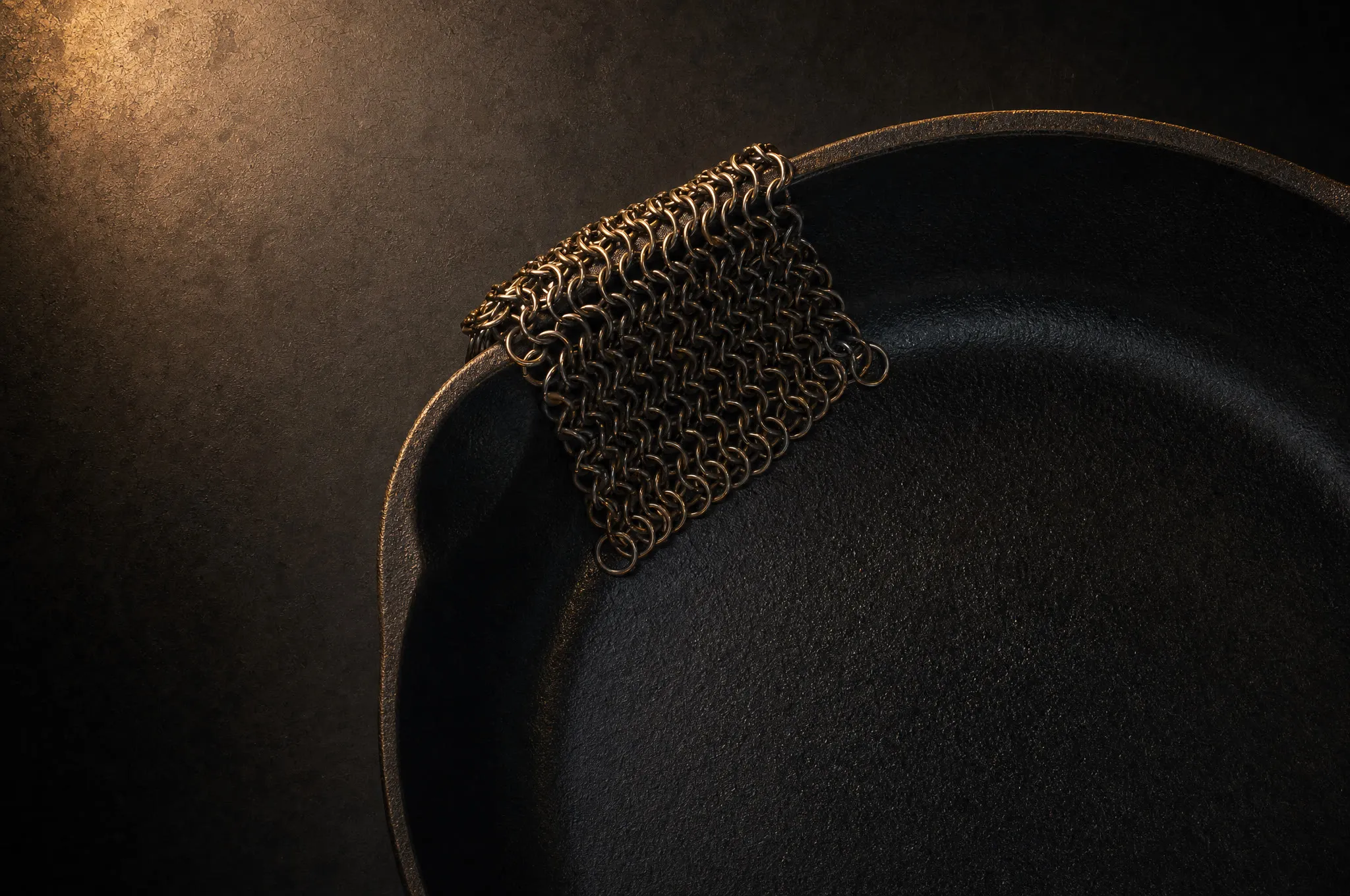
A chainmail scrubber is the one cast iron accessory that’s actually essential. Its smooth stainless rings shear stuck food and carbon off the pan without cutting into the cured seasoning underneath — hot water and light pressure do the rest. Get the silicone-core style: easier to hold, and it presses the rings flat against the cooking surface.
Most cast iron accessories are solutions looking for a problem. Pan scrapers, seasoning pucks, handle covers — nice, skippable. The chainmail scrubber is the exception: it solves the problem every skillet owner has every day, in a way nothing else at the sink can. Here’s the physics, the two styles, what it won’t fix, and how to use it right.
Why chainmail beats everything else at the sink
Start with what you’re actually scrubbing. The stuff that needs to come off a used skillet — seared-on food, carbonized drips, gummy patches of half-cooked oil — sits on top of the seasoning. It’s brittle and lumpy, and it stands proud of the surface. The seasoning itself is a different material entirely: oil polymerized into a thin, hard film, bonded to the iron and lying dead flat.
Chainmail exploits that difference. The rings are smooth stainless loops with no cutting edge. Drag them across a flat, bonded film and they have nothing to catch — they slide. Drag them across a lump of carbon and the lump catches between the rings and gets sheared sideways off its base. The scrubber isn’t gentle because you press lightly; it’s selective by geometry. It can’t bite into what lies flat, and it can’t help knocking off what sticks up.
Now compare the alternatives. Steel wool is thousands of tiny blades — it abrades everything it touches, seasoning included. Scouring powder, same story. A sponge slides over the lumps and polishes them instead of removing them. A plastic scraper works, but only where you drive its edge, one stubborn patch at a time. Coarse salt works once, then goes down the drain. Chainmail does the whole pan in about a minute, rinses clean, and is ready to do it again tomorrow.
One note on those gummy patches: they’re usually a symptom, not dirt. A too-thick oil coat that never fully cured stays soft and tacky, and the scrubber will take it off — but why is my cast iron sticky explains how to stop making it in the first place.
Silicone core vs. rings-only
Every chainmail scrubber worth owning is one of two styles, and the difference is bigger than it looks on the product page.
Silicone-core scrubbers wrap the mail around a flexible silicone puck. The core does two jobs: it gives your hand something solid to hold when the sink is wet and greasy, and it presses the rings flat and evenly against the cooking surface, so every pass covers real area instead of a wandering line. It holds its shape, dries fast, and never wads up into a knot mid-scrub. For the flat floor of a skillet — where nearly all the scrubbing happens — it’s simply faster.
Ring-only scrubbers are the classic: a flat round or square of pure mail, nothing else. What they give up in grip they return in flexibility. The mail drapes around curves, folds into the corner where the wall meets the floor, and wraps pour spouts and handle roots. There’s no core to ever split, and the thing packs flat in a camp kit. If your cleanup runs to Dutch ovens and deep-walled pans, the classic earns its place.
Our pick is the core style, because the daily job is flat. If you cook in anything with serious corners, there’s no rule against owning both.
What a chainmail scrubber won’t fix
Chainmail removes what sits on top of the seasoning. It does nothing for problems that live in or under the seasoning, and it’s worth knowing that boundary before you scrub harder at something scrubbing can’t solve.
Rust. The rings will knock loose orange dust off a rusty patch and make it look better for a day. Nothing got fixed — rust is the iron itself oxidizing, and it keeps going until the rust is removed completely and the bare spot is re-seasoned. That’s a different job with its own steps: how to remove rust from cast iron.
Full strip-downs. A thrift-store pan wearing decades of crusted carbon is beyond any scrubber. Chainmail will burnish the top of the crust and get nowhere near the iron. The way back to bare metal is chemistry, not elbow grease — a lye bath dissolves the buildup without touching the metal underneath.
How to use it right
- Scrub soon after cooking, while the pan is still warm. Warm residue lets go easily; the same residue cooled overnight sets hard. Warm means comfortable to handle — not fresh off the burner and spitting steam at your knuckles.
- Hot running water. Water is doing half the work, softening the residue while the rings shear it. Let it run over the pan as you go.
- Light pressure, small circles. The geometry does the cutting, not your arm. Bearing down doesn’t reach deeper — it just wears out your wrist.
- If light pressure isn’t winning, add heat, not force. Splash in some water and set the pan over low heat for a minute or two. The simmer lifts the stuck layer from underneath, and what fought the scrubber wipes out like nothing.
- Dry completely and wipe with a thin film of oil. Same close as always — a scrubbed pan left wet on the rack is how rust gets its opening.
Cleaning the scrubber itself
Here’s the small irony: the tool that cleans the pan that must never see a dishwasher is itself completely dishwasher-proof. After each use, rinse it under hot water and rub it against itself to work debris out of the rings, then shake and let it dry. When it goes dull and greasy, run it through the dishwasher — stainless rings and silicone cores both shrug it off and come out looking new. The pan, to be clear, stays out of the machine; rust spots after a dishwasher run is its own cautionary tale.
No, it won’t strip your seasoning
This is the fear that keeps people scrubbing cast iron with a soft sponge and losing the fight every night, and it belongs to the same family as the soap myth: treating cured seasoning like a fragile coating instead of what it is — a hard, bonded polymer. Smooth rings under hand pressure don’t cut it, for the same reason they don’t scratch your sink.
If a pass of chainmail does take black flakes off your pan, the scrubber didn’t kill healthy seasoning. It found material that was already loose — carbon buildup or a failing layer that was going to let go into your dinner instead. Better in the sink. If the flaking keeps coming, the seasoning underneath needs attention: fixing flaking seasoning covers the scrub-back and rebuild.
The bottom line
One accessory earns a permanent hook by the sink, and this is it. A silicone-core chainmail scrubber takes off what cooking leaves behind, leaves the seasoning you built, and asks for nothing but a rinse in return. Use it warm, use it with hot water, keep the pressure light. It won’t cure rust and it won’t resurrect a crusted estate-sale pan — but it will make every ordinary cleanup a one-minute job for as long as you own the pan.
The rest of the kit — what’s worth buying and what’s safely skippable — lives in the buying guide.
FAQ
Will a chainmail scrubber remove the seasoning on my cast iron?
No. Cured seasoning is a hard polymer film bonded flat to the iron, and the rings are smooth stainless loops with no cutting edge — they slide over what lies flat and only shear off deposits that stand proud. If black flakes come off under light pressure, that material was already loose: carbon buildup or failing seasoning that would have ended up in your food.
Can I use a chainmail scrubber on enameled cast iron or nonstick?
No. Chainmail is for bare cast iron and carbon steel only. Enamel is glass — the rings will leave fine scratches and dull the gloss over time — and nonstick coatings are far too soft for it. For enameled pans, use a sponge and let a warm-water soak do the heavy lifting.
How do I clean the chainmail scrubber itself?
Rinse it under hot running water right after use, rub it against itself to knock the debris out of the rings, shake, and let it dry. When it gets dull and greasy, run it through the dishwasher — stainless rings and a silicone core both come out fine. It's the one tool at the cast iron sink that genuinely doesn't mind the machine.
Is a chainmail scrubber better than a stiff brush or pan scraper?
It covers more jobs than either. A brush handles light daily cleanup but skates over set carbon; a plastic scraper shifts stuck patches but only where you drive its edge. Chainmail does both jobs across the whole pan at once. Keep a scraper for pressed corners if you like — but if you're buying one tool, this is the one.