Buying 6 min read
Smithey vs. Field Company: The Heirloom and the Daily Driver, Compared Honestly
Smithey and Field Company both make smooth, vintage-style cast iron — with opposite ideas about weight. An honest comparison, and who each premium pan suits.
This guide has product links. As an Amazon Associate, Seasoned Cast earns from qualifying purchases — it never changes what we recommend.
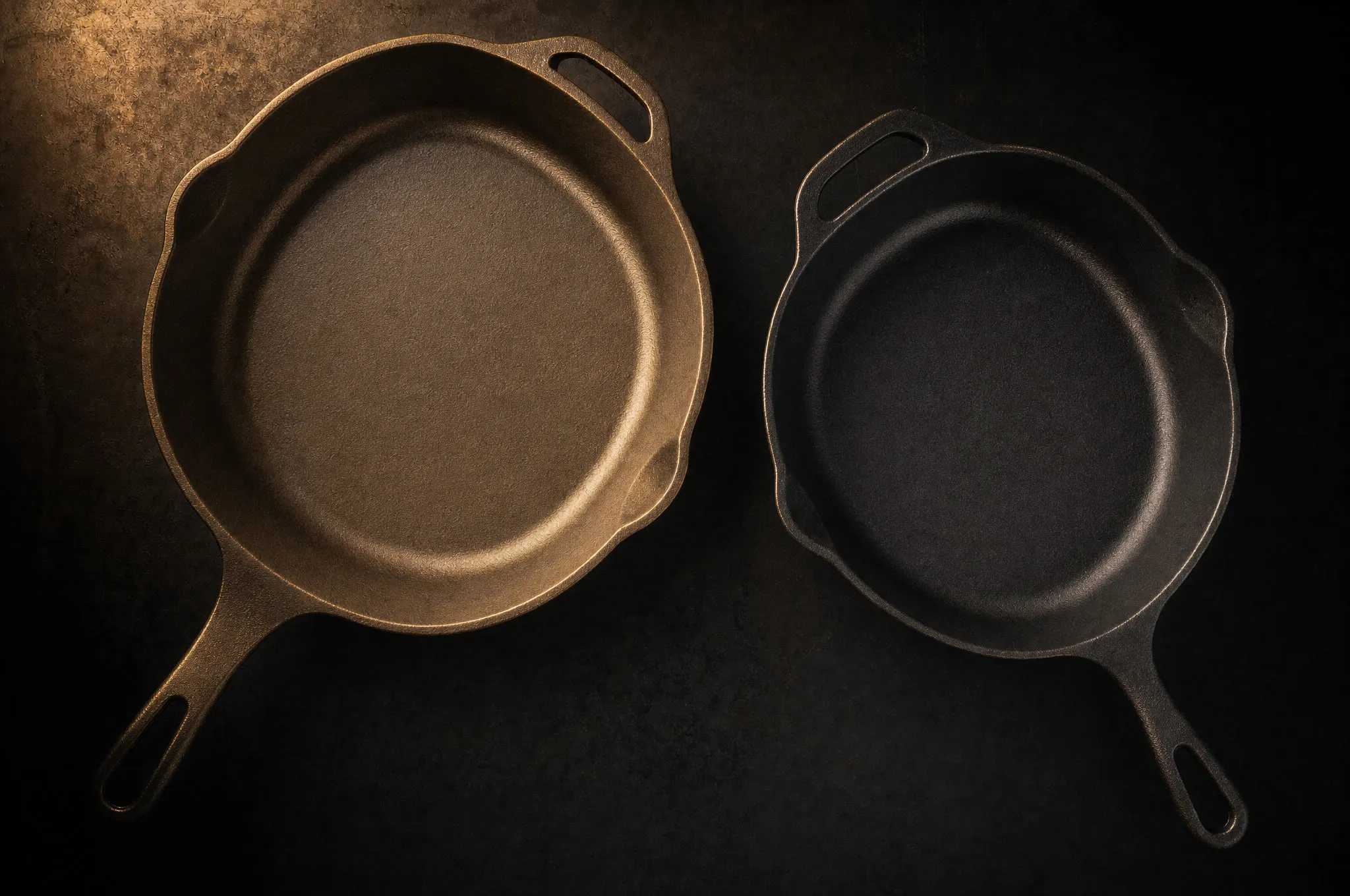
Field Company if you cook every night and feel a pan’s weight; Smithey if you want the heirloom object and the searing mass. Both machine their cooking surfaces smooth the way vintage iron was made, both sit in the same premium tier, and both are excellent. They just disagree — deliberately — about what a cast iron skillet should weigh.
That disagreement is the whole comparison, so let’s have it out properly.
Two answers to the same vintage question
Old cast iron — the skillets your grandmother’s kitchen ran on — was cast thin and machined to a smooth, almost slick cooking face. Modern budget iron dropped the machining decades ago: pans got thicker, surfaces got pebbly, and prices got wonderfully low. Smithey and Field Company are the two best-known American makers who brought the machined surface back, and they charge accordingly for it.
From that shared starting point, they walked in opposite directions. Smithey builds the heirloom: polished to a warm bronze tone, heritage-styled, and usually the noticeably heavier pan in a comparable size — mass treated as a feature. Field builds the daily driver: deliberately lightweight, visually quiet, closer in spirit to the thin vintage skillets that inspired it. Neither company is confused about who its pan is for. Your only job is figuring out which one is you.
The comparison at a glance
| Smithey | Field Company | |
|---|---|---|
| Cooking surface | Polished smooth — near-glassy under the seasoning | Machined smooth — a vintage-style satin |
| Weight philosophy | Mass on purpose: retention and sear | Light on purpose: handling and daily use |
| In the hand | Substantial, planted, deliberate | The closest new iron gets to vintage-light |
| Looks | Warm bronze polish, heritage details | Matte, spare, design-quiet |
| Personality | Heirloom on display | Tool in rotation |
| Strongest at | Steaks, frying, holding temperature | Weeknight everything: eggs, vegetables, lifting, tossing |
| As a gift | Wins the unboxing | Wins the months after |
| Price tier | Premium | Premium |
Same surface promise, opposite builds. Here’s what each row means at the stove.
Both faces are smooth — here’s what that actually buys
The machined surface is the reason either of these pans exists, so start there. A smooth face wipes clean in seconds, takes a metal spatula without complaint, and releases food a little earlier in its seasoning life than a pebbly one. Run a finger across either pan and you understand the price tag in a way no spec sheet conveys. It feels like the old iron people hunt estate sales for.
Now the honest part: smoothness changes how the pan feels, not what it cooks. Release comes from seasoning, fat, and patience — a rough-faced budget skillet with a year of black seasoning fries the same egg. Both premium pans still want the same oven seasoning routine, the same dry-it-hot habit, the same thin wipe of oil after cooking. And a polished face starts with less texture for seasoning to grip, so expect the first weeks to look blotchy while the layers build. That’s normal, not a defect. Keep cooking.
Weight: the real disagreement
Everything else about these two pans is a footnote to this.
Smithey’s bet is mass. A heavy pan is thermal ballast — slow to heat, very hard to knock off temperature. Lay a thick steak in a properly preheated heavy skillet and the surface barely dips; that’s how you get a crust from edge to edge instead of a gray band around a scorched middle. Frying, cornbread, anything that goes stove-to-oven — set-and-hold cooking rewards weight, and Smithey leans into it without apology.
Field’s bet is that you’ll actually pick the pan up. A skillet only improves your cooking on the nights you reach for it, and weight is the quiet reason iron sits in the cabinet while the beat-up nonstick does another Tuesday. A noticeably lighter pan flips vegetables with a wrist snap, slides an omelet out one-handed, and travels from stove to sink without ceremony. Field’s whole design brief is that vintage-light feel — the pan disappears and the cooking is just cooking.
Neither bet is wrong; they’re optimized for different nights of the week. Smithey is engineered for the Saturday steak. Field is engineered for the other six dinners. Count which kind of night your kitchen actually has more of, and this section has made your decision for you.
Looks, and the gift question
Cookware this expensive is partly an object, so it’s fair to judge it as one.
Smithey is the showpiece. The warm bronze-toned polish, the heritage styling, the whole presentation — it photographs like a family artifact from the day it arrives, and it’s the kind of pan that ends up hung on the wall between uses. If part of the purchase is the moment someone unwraps it, Smithey wins that moment walking away. This is the registry pan, the milestone-birthday pan, the pan you imagine a kid arguing over in forty years.
Field is the opposite kind of handsome: matte, minimal, no flourish anywhere. It looks like a tool because it is one, and it looks better the more cooked-on and black it gets. Nobody gasps when they unwrap a Field. They just quietly cook on it four hundred times over the next two years, which is its own kind of compliment.
Both arrive seasoned and ready to cook, and both re-season like any other iron — the aesthetics are the difference, not the upkeep.
What the premium price doesn’t buy
Here’s the paragraph a sales page would skip. Neither of these pans cooks better food than iron costing a fraction as much. A basic Lodge holds heat, sears hard, and bakes cornbread just as well — it outcooks its price against either premium pan, which is exactly why it’s our standard first-skillet recommendation. If the budget stings even slightly, buy the Lodge, spend the difference on steaks, and revisit the premium tier once you know you’re an iron person.
And if what you’re really chasing is the smooth machined face, the original version is still out there. Vintage skillets deliver that slick, light, old-iron feel for flea-market money — the Lodge-versus-vintage question is its own comparison, and vintage wins it more often than people expect.
None of that is a knock on Smithey or Field. It’s the context that makes buying one an honest luxury instead of a mistaken necessity.
Which one
Buy Field Company if the pan is for cooking. Daily eggs, weeknight vegetables, the skillet that lives on the stovetop because it never stops being used — the lighter build and quiet looks are exactly right for a pan in constant rotation. It’s the premium iron we’d point a serious home cook toward.
Buy Smithey if the pan is also for keeping. The heavy, planted build makes it a genuine sear machine, and the bronze-polished heritage look makes it the best gift in the category. For a wedding, a first house, or your own shelf of things that outlast you, it’s the one.
Genuinely torn? Decide by nights, not specs: mostly weeknight cooking, take Field; mostly weekend projects and a pan you want to admire, take Smithey. And if neither premium story grabs you, that’s an answer too — a cheap Lodge and a little patience deliver the same dinner, and the rest of the buying guides will happily prove it.
FAQ
Are Smithey and Field Company pans made in the USA?
Yes — both companies cast and finish their iron in the United States, and that domestic manufacturing is a real part of the premium price. It also means origin can't break the tie between them. Worth knowing: the budget benchmark, Lodge, is American-made too — cast iron is one category where the cheap option isn't the imported one.
Do polished premium pans season differently than a rough Lodge?
Same chemistry, same routine — the standard oven method works identically on all of them. The one difference is cosmetic: a polished face gives those first seasoning layers less texture to grip, so early seasoning can look patchy or bronze-streaked. Keep cooking and wiping with a thin coat of oil after each use; it evens toward black.
Is Smithey or Field Company actually worth it over a basic Lodge?
Not on cooking results — a well-seasoned Lodge sears the same steak for a fraction of the money. What the premium buys is feel: the smooth machined face, the weight philosophy you prefer (mass from Smithey, lightness from Field), and looks you'll enjoy for decades. Buy one as an upgrade or a gift, not as a requirement for good food.
Which one makes the better gift?
Smithey, if the moment matters — the warm polished finish and heritage styling read as special the second the box opens, which is why it shows up on wedding registries. Field, if the recipient cooks constantly — lighter iron simply gets used more. Milestone occasion: Smithey. The friend who cooks every night: Field.